AI model
Praxis-1
By Runway, United States (checked on github.com/runwayml (opens in a new tab)), from github.com/runwayml/praxis-1-oss (opens in a new tab)
- Humanoids and robot learning
- Apache-2.0 (code)
- Apache-2.0 (weights)
Praxis-1 is a video-action policy for robot arms that predicts future video and action chunks from a task string and camera frames.
Facts
- Code last updated
- 18 Nov 2026Newest commit on main
- Maintenance
- Activea commit in the last 90 days
- Difficulty
- Advanced
- Hardware it needs, as the project states it
- Python 3.12 and one CUDA GPU with at least 80 GB of memory (one H100 is sufficient), CUDA 13.0 driver; optional NVFP4 path needs an SM120 GPU (RTX 5090 or RTX PRO 6000 Blackwell).
Checked on GitHub on 18 Nov 2026.
Licenses
- Code
- Apache-2.0 (opens in a new tab)
Read by Robotheca from LICENSE (opens in a new tab) (Apache-2.0) at commit 8de6df6 (opens in a new tab), on 18 Nov 2026.
- Weights
- Apache-2.0 (opens in a new tab)
Read on huggingface.co/runwayml/praxis-1-base (opens in a new tab).
- Commercial use
- Yes
At a glance
- What it is
- Predicts the next video chunk and action chunk per policy call, and the robot executes the action chunk.
- Takes a task string, two camera frames (exterior and wrist), up to three context chunks, and the arm pose.
- Outputs robot commands at 15 Hz as target pose and gripper values, with a 21-row first chunk and 24-row later chunks.
- Provides a single-arm DROID checkpoint and a bimanual YAM checkpoint, plus a base checkpoint for fine-tuning to new rigs.
- Includes a MuJoCo simulation with seven tasks, a suite for evaluating checkpoints, and a policy server.
- Offers an experimental NVFP4 path for routed experts on SM120 GPUs, with accuracy not yet confirmed in closed loop.
Robotheca's summary of the project's documents, not the creator's words.
- Robots on Robotheca
- Used by AIRA, AlohaMini2, AlohaScorpion, AM-ARM200 and 13 more.
- Licence
- Apache-2.0 (code); Apache-2.0 (weights). Commercial use: Yes. Where it was read
- Load it
- In the creator's words: The project's README (opens in a new tab)
- Maintenance
- Active, last commit on 18 Nov 2026.
Works with
17 robots on Robotheca
The robots on Robotheca that use it or can run it, each with how the link was found.
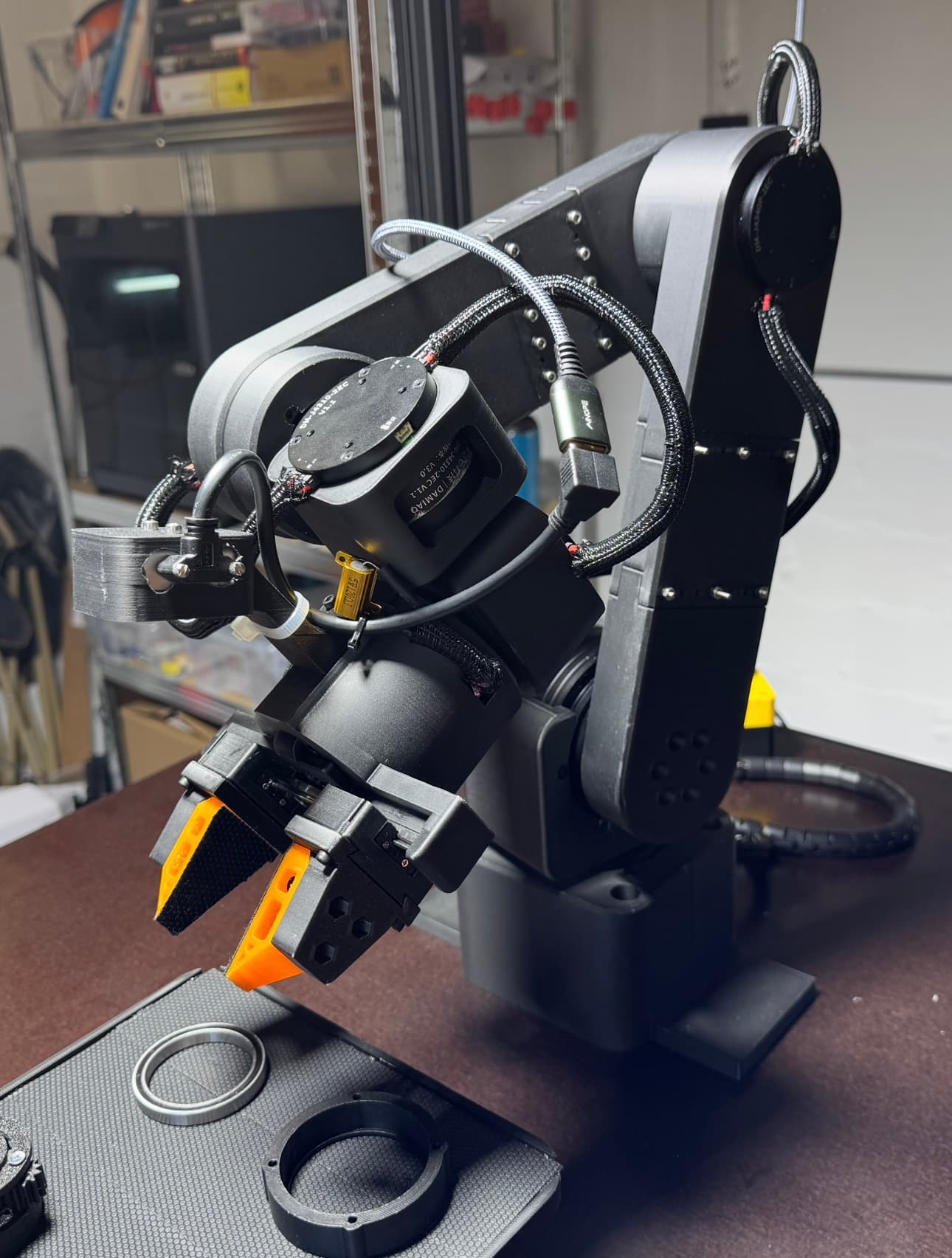
Praxis-1 is a LeRobot policy (since 11 November 2026), and this robot runs LeRobot; at 27.2B parameters it needs a large GPU.
- No photo yet
Praxis-1 is a LeRobot policy (since 11 November 2026), and this robot runs LeRobot; at 27.2B parameters it needs a large GPU.
- No photo yet
Praxis-1 is a LeRobot policy (since 11 November 2026), and this robot runs LeRobot; at 27.2B parameters it needs a large GPU.
- Ready to build
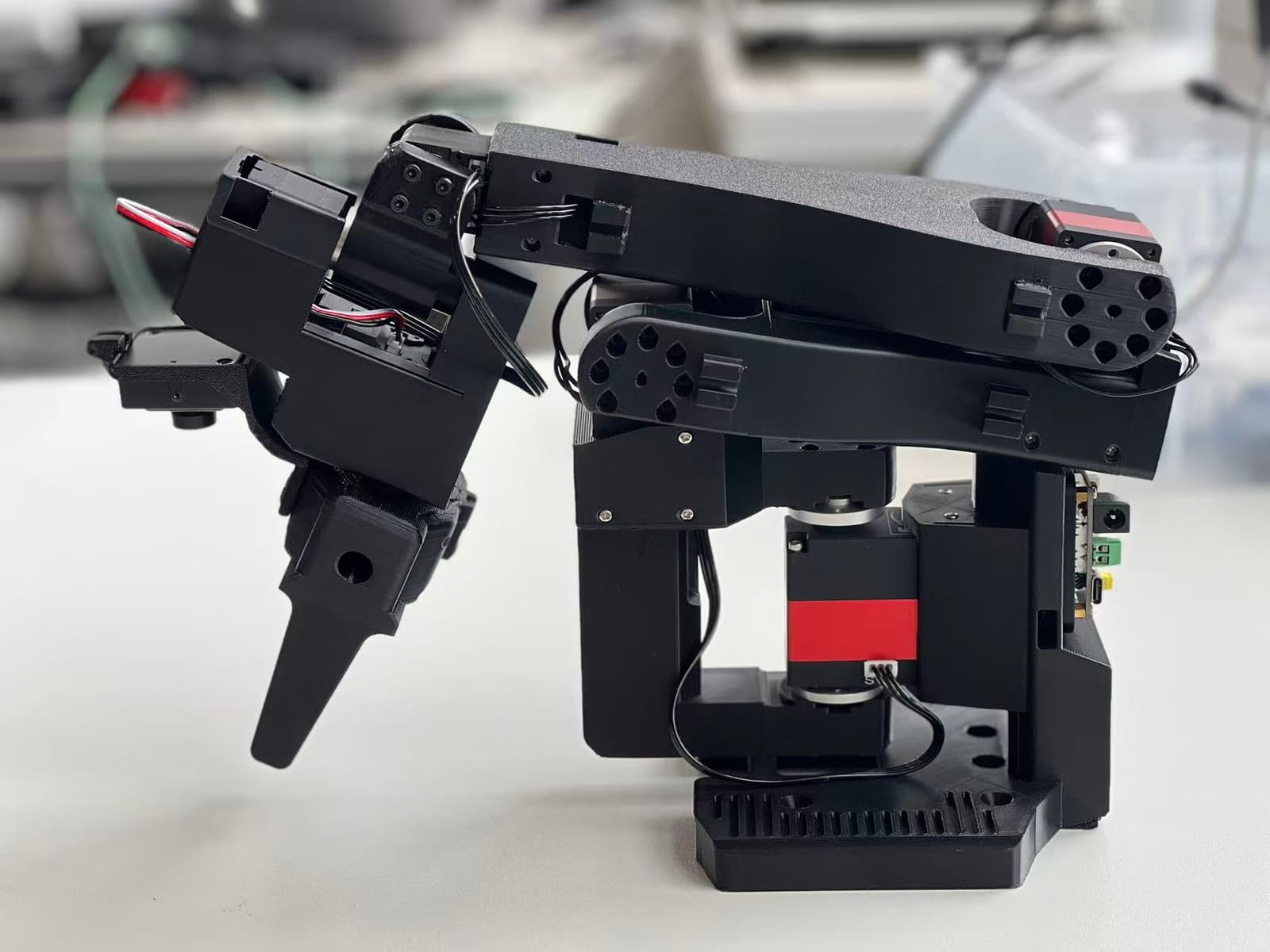
Open source · free files
AM-ARM200
Robot arm · Intermediate
- Score
- Buildability 86 out of 100
- Cost
- $380≈ €346
Praxis-1 is a LeRobot policy (since 11 November 2026), and this robot runs LeRobot; at 27.2B parameters it needs a large GPU.
- No photo yet
Open source · free files
Berkeley Humanoid Lite Arm (BHL v1.5)
Robot arm · Intermediate
- Score
- Buildability 75 out of 100
- Cost
- Not stated
Praxis-1 is a LeRobot policy (since 11 November 2026), and this robot runs LeRobot; at 27.2B parameters it needs a large GPU.
Open source · free files
Delta Robot ACT vs. Diffusion Policy
Robot arm · Advanced
- Score
- Buildability 56 out of 100
- Cost
- Not stated
Praxis-1 is a LeRobot policy (since 11 November 2026), and this robot runs LeRobot; at 27.2B parameters it needs a large GPU.
- Ready to build
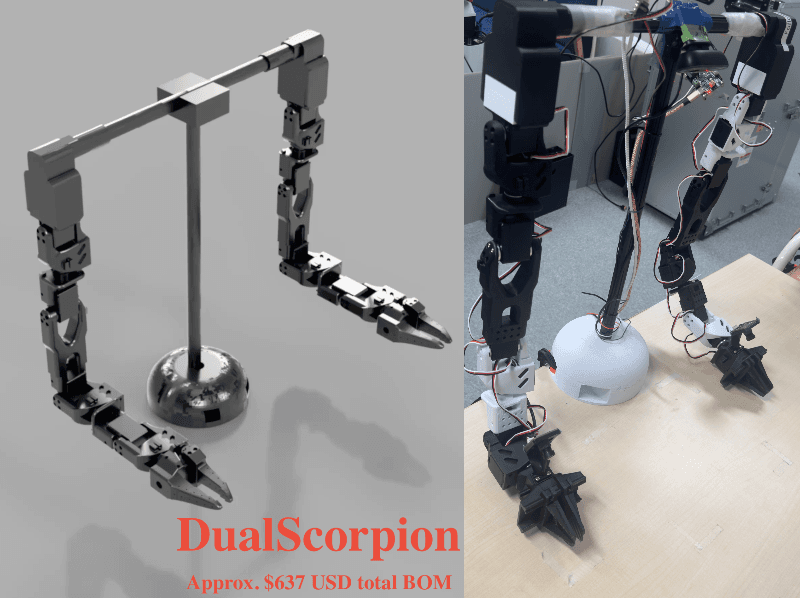
Open source · free files
Dual Scorpion
Robot arm · Advanced
- Score
- Buildability 100 out of 100
- Cost
- $486.88≈ €443
Praxis-1 is a LeRobot policy (since 11 November 2026), and this robot runs LeRobot; at 27.2B parameters it needs a large GPU.
- No photo yet
Praxis-1 is a LeRobot policy (since 11 November 2026), and this robot runs LeRobot; at 27.2B parameters it needs a large GPU.
- Ready to build
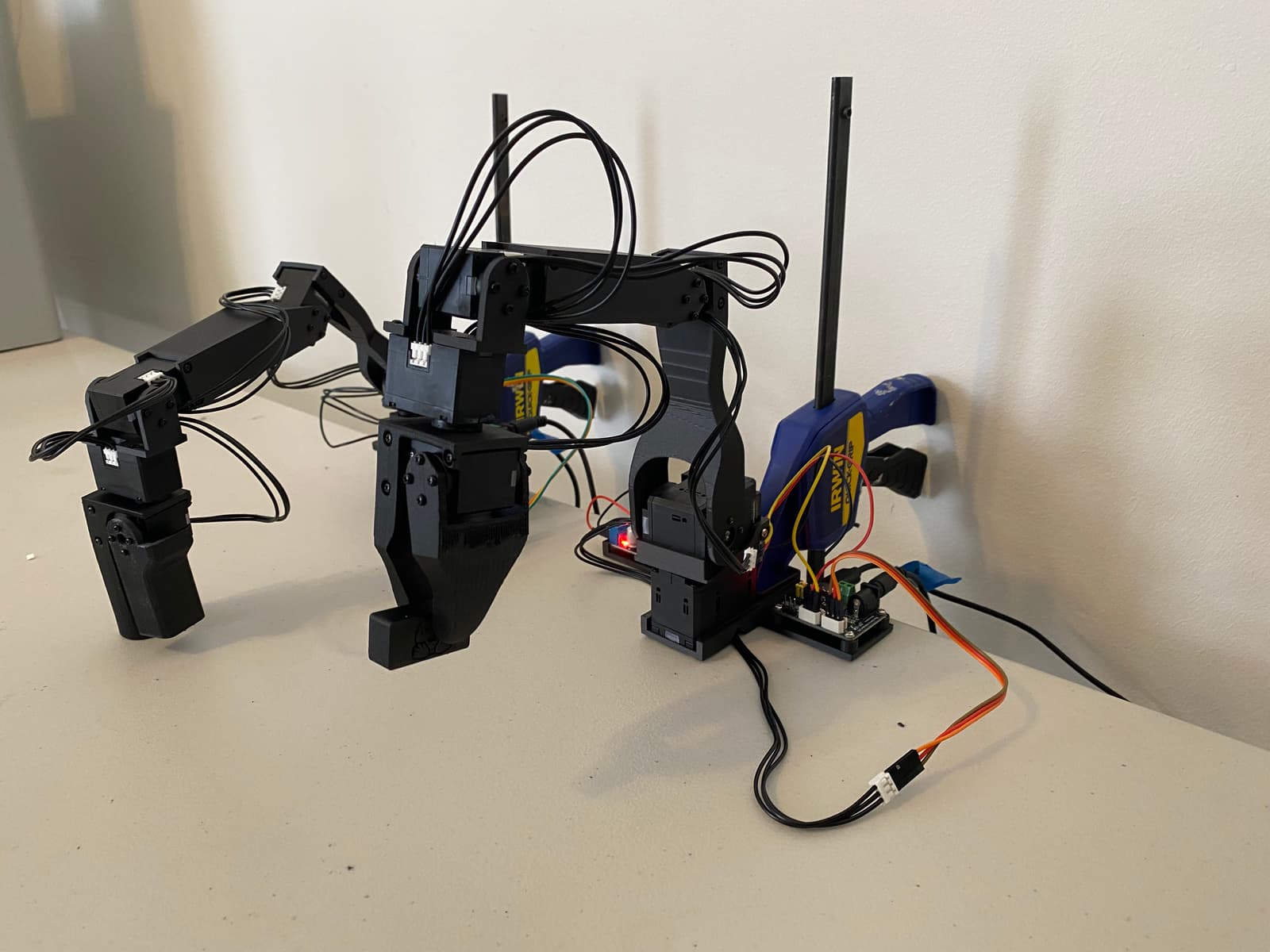
Praxis-1 is a LeRobot policy (since 11 November 2026), and this robot runs LeRobot; at 27.2B parameters it needs a large GPU.
- Ready to build
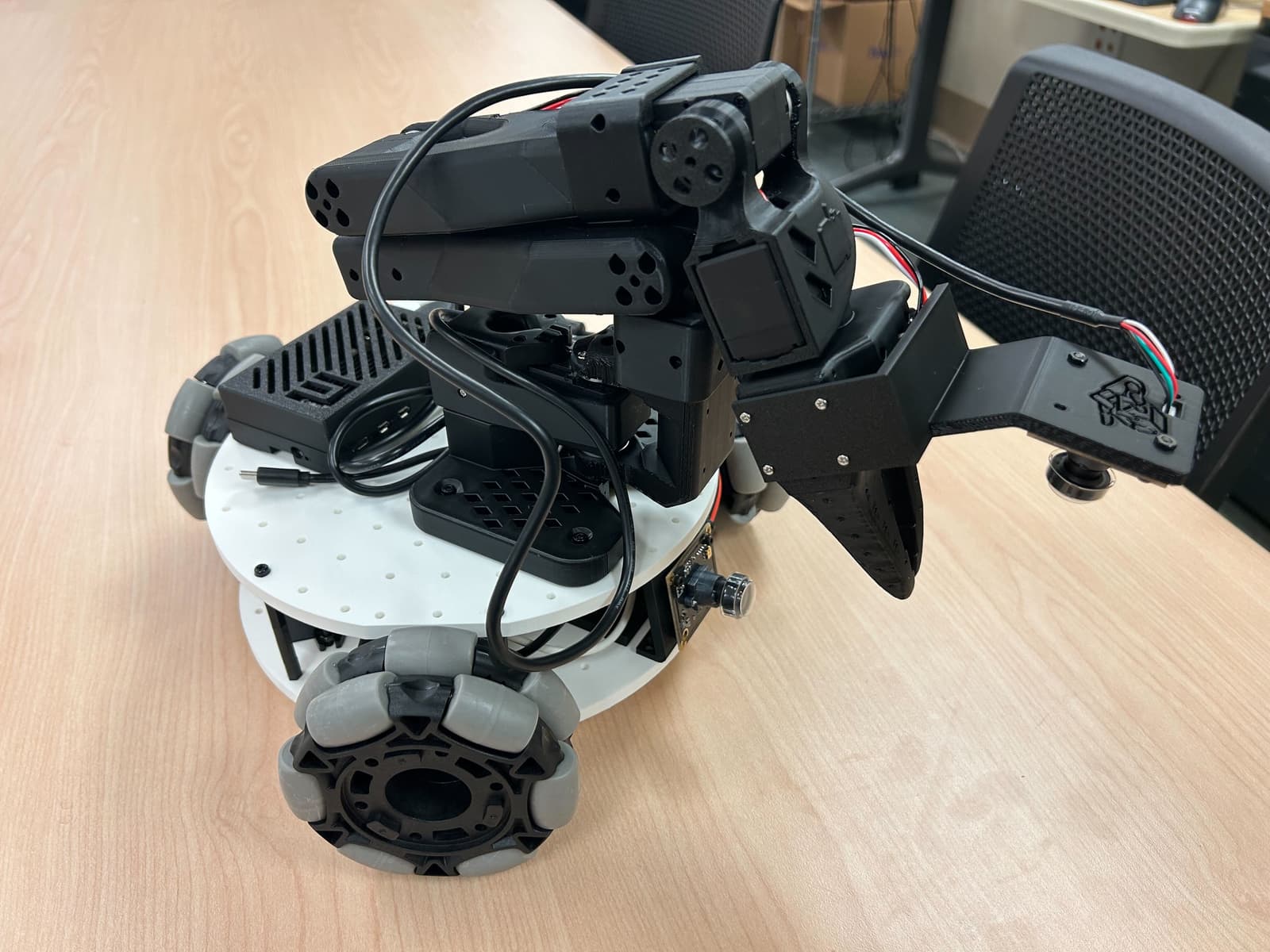
Praxis-1 is a LeRobot policy (since 11 November 2026), and this robot runs LeRobot; at 27.2B parameters it needs a large GPU.
- No photo yet
Open source · free files
OpenK Arm
Robot arm · Intermediate
- Score
- Buildability 69 out of 100
- Cost
- Not stated
Praxis-1 is a LeRobot policy (since 11 November 2026), and this robot runs LeRobot; at 27.2B parameters it needs a large GPU.
- Ready to build
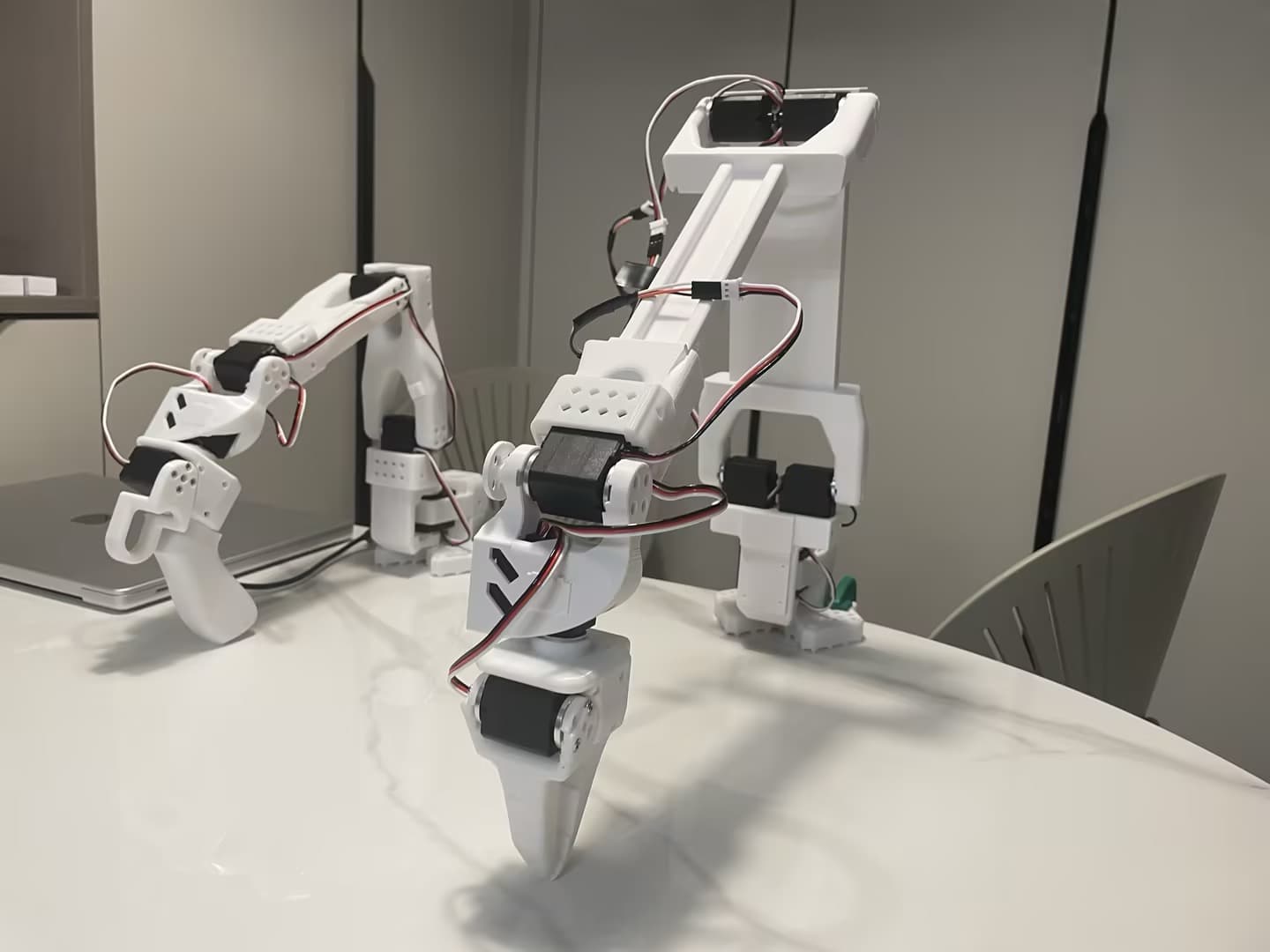
Open source · free files
PingTi Arm
Robot arm · Intermediate
- Score
- Buildability 89 out of 100
- Cost
- $261≈ €237
Praxis-1 is a LeRobot policy (since 11 November 2026), and this robot runs LeRobot; at 27.2B parameters it needs a large GPU.
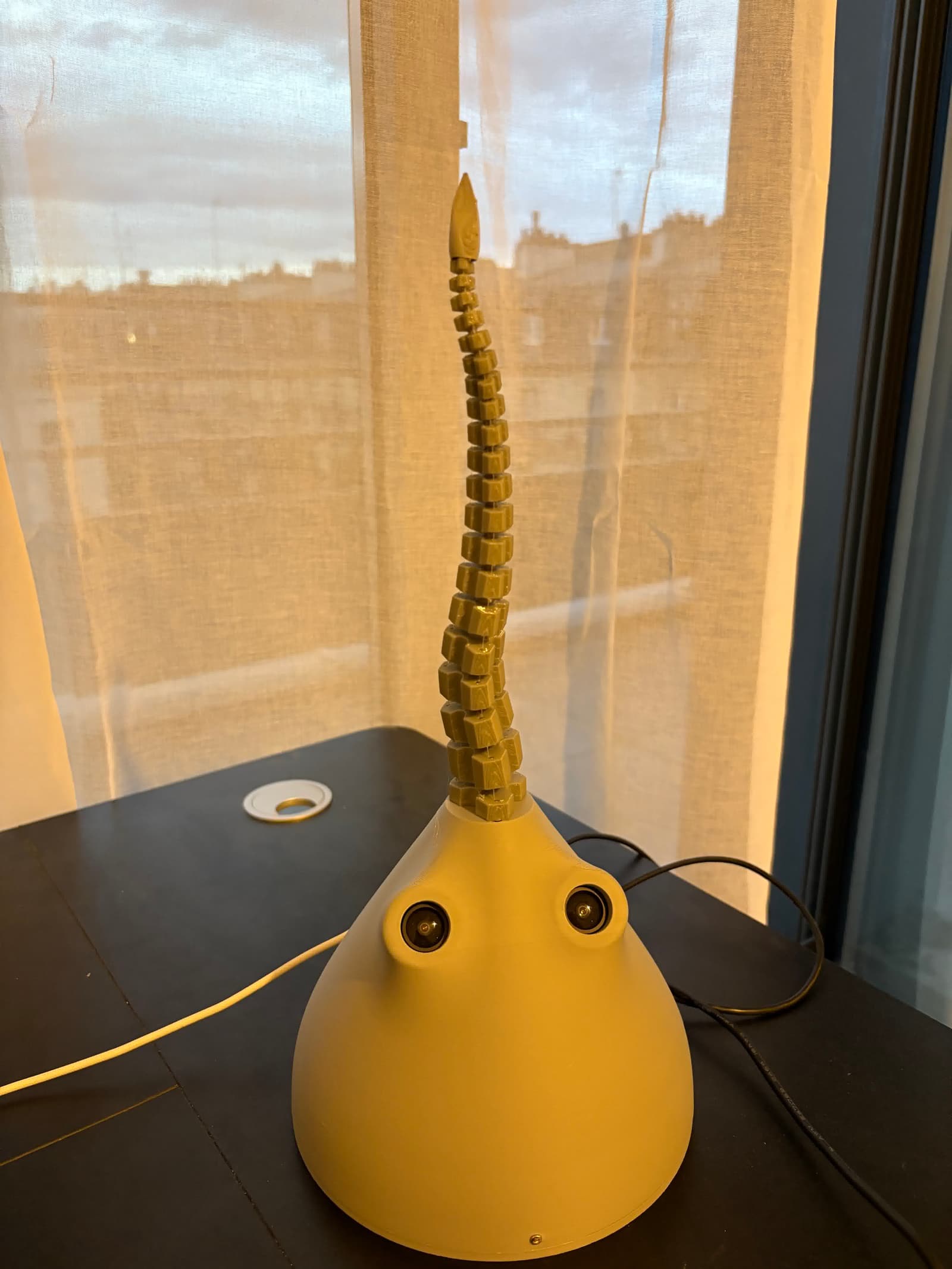
Open source · free files
Shoggoth Mini
Other · Advanced
- Score
- Buildability 65 out of 100
- Cost
- under $200≈ up to €182
Praxis-1 is a LeRobot policy (since 11 November 2026), and this robot runs LeRobot; at 27.2B parameters it needs a large GPU.
- Ready to build
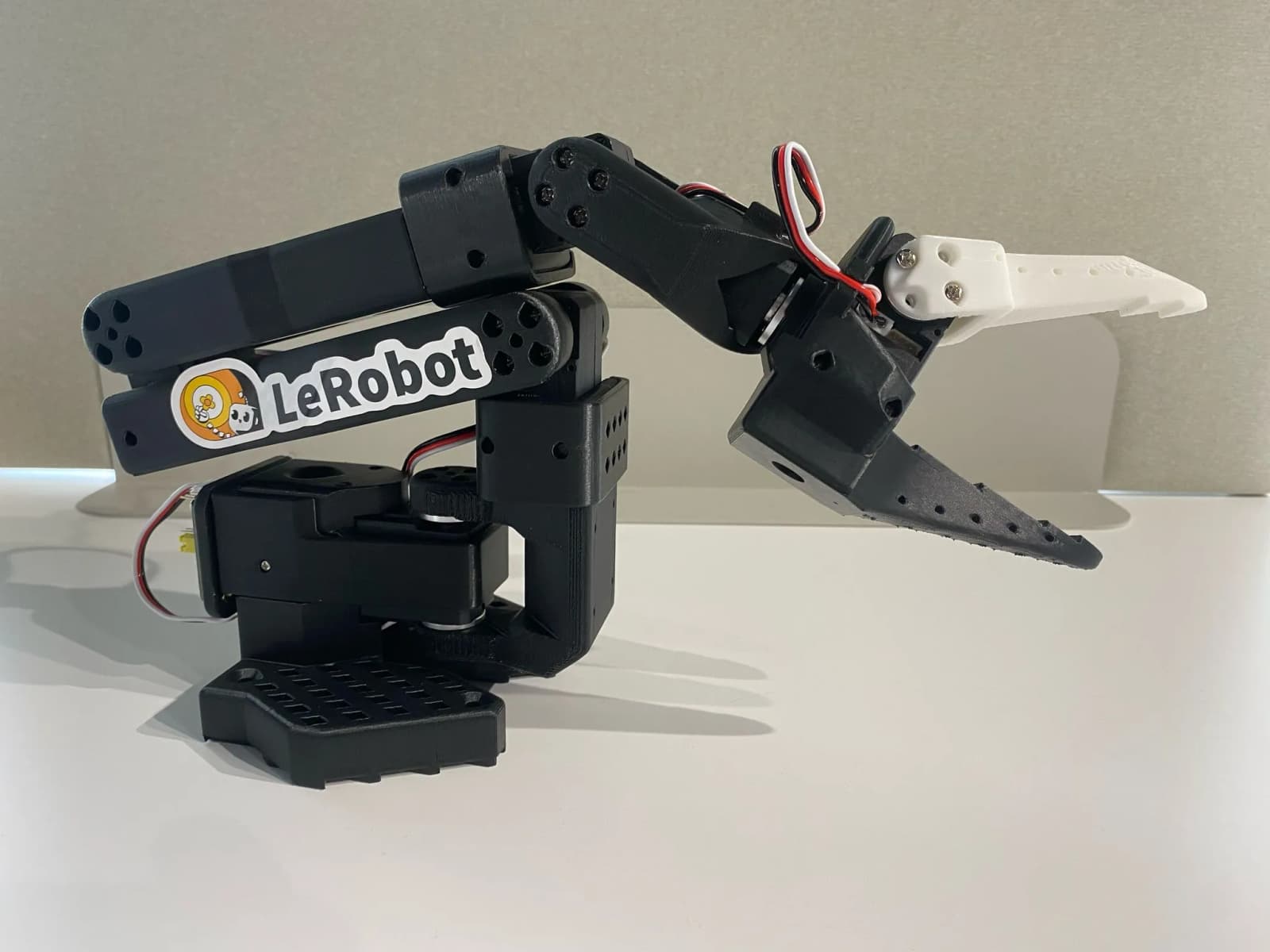
Praxis-1 is a LeRobot policy (since 11 November 2026), and this robot runs LeRobot; at 27.2B parameters it needs a large GPU.
- Ready to build
Open source · free files
SO-ARM 102
Robot arm · Intermediate
- Score
- Buildability 84 out of 100
- Cost
- $414.21≈ €377
Praxis-1 is a LeRobot policy (since 11 November 2026), and this robot runs LeRobot; at 27.2B parameters it needs a large GPU.
Open source · free files
TRLC-DK1
Robot arm · Intermediate
- Score
- Buildability 69 out of 100
- Cost
- Not stated
Praxis-1 is a LeRobot policy (since 11 November 2026), and this robot runs LeRobot; at 27.2B parameters it needs a large GPU.
- Photo on GitHub
Praxis-1 is a LeRobot policy (since 11 November 2026), and this robot runs LeRobot; at 27.2B parameters it needs a large GPU.
Use it
How to load it, in the creator's words: The project's README (opens in a new tab)
Robotheca doesn't review code. Read it before running it.
Files and versions
Facts read at commit 8de6df6
- Repository on GitHubgithub.com/runwayml/praxis-1-oss (opens in a new tab)
- The version Robotheca read8de6df6 (opens in a new tab)
- Latest releaseNone published on GitHub
- LeRobot, where Praxis-1 is a policy (src/lerobot/policies/praxis, since 11 November 2026)github.com/huggingface/lerobot (opens in a new tab)
- Praxis-1 fine-tuned on DROID (Apache-2.0)huggingface.co/runwayml/praxis-1-droid (opens in a new tab)
- praxis-1-droid in LeRobot's policy layout (Apache-2.0)huggingface.co/runwayml/praxis-1-droid-lerobot (opens in a new tab)
- Model card on Hugging Facehuggingface.co/runwayml/praxis-1-base (opens in a new tab)
Robotheca read the repository at two versions: the summary at 94c5b3f and the facts and the README at 8de6df6 (read on 18 Nov 2026).
Robotheca never hosts the code or the weights: each link goes to the creator's own page.
The README and the model card
The creator's own README, copied as written: README.md by Runway, at commit 8de6df6, under Apache-2.0 (opens in a new tab). The original on GitHub (opens in a new tab).
Read the README here
Praxis-1
(opens in a new tab) Image: Model on HF (opens in a new tab) (opens in a new tab) (opens in a new tab) (opens in a new tab)
Praxis is a video-action policy for robot arms. There are two checkpoints of
one model variant: praxis-1-droid, the single-arm checkpoint, for a
single-arm robot with an exterior camera and a wrist camera (the DROID rig),
and praxis-1-yam, the bimanual checkpoint, for two YAM arms with a top
camera and two wrist cameras (see Bimanual rig).
For each policy call, the model predicts the next video chunk and the next
action chunk. The robot then executes the action chunk.
Both checkpoints also have NVFP4 versions, fine-tuned with quantization-aware
training of the routed experts:
runwayml/praxis-1-droid-nvfp4 (opens in a new tab)
and runwayml/praxis-1-yam-nvfp4 (opens in a new tab)
(see Get the weights). For the SO-100 / SO-101 arm there
are runwayml/praxis-1-so101 (opens in a new tab)
and its NVFP4 version
runwayml/praxis-1-so101-nvfp4 (opens in a new tab)
(see SO-101 rig).
This repository holds the inference code and the instructions to run it. The
code needs PyTorch and a few small packages. It does not need any other code
base. praxis/train/README.md tells how to fine-tune praxis-1-base for
your rig, with DROID as the worked example, and how to adapt praxis-1-droid
to a task with LoRA on one 80 GB GPU. praxis/sim/EVAL.md tells how to measure a checkpoint on the
simulated DROID tasks.
Quick start
Clone the repository, install it, download the weights from Hugging Face
and run the single-arm checkpoint in the simulation. It needs Python 3.12,
one CUDA GPU with at least 80 GB of memory and the CUDA 13.0 driver. Log in
to Hugging Face once first (hf auth login); the hf command comes with
transformers, so log in after the install if you don't have it yet. The
install uses uv (opens in a new tab): pip install uv, or
curl -LsSf https://astral.sh/uv/install.sh | sh.
git clone https://github.com/runwayml/praxis-1-oss.git praxis-1 && cd praxis-1
uv venv --python 3.12 .venv && . .venv/bin/activate
uv pip install torch==2.13.0 torchvision==0.28.0 --index-url https://download.pytorch.org/whl/cu130
uv pip install packaging ninja wheel
CAUSAL_CONV1D_FORCE_BUILD=TRUE MAX_JOBS=16 \
  uv pip install --no-build-isolation --no-cache causal-conv1d==1.6.1
uv pip install -e packages/praxis-sim -e ".[kernels]" "imageio>=2.30" "imageio-ffmpeg>=0.4"   # praxis and praxis-sim from this checkout
uv pip install "flash-attn-4[cu13]==4.0.0b36"
uv pip install --no-deps nvidia-cudnn-cu13==9.24.0.43   # after every install that resolves torch

hf download Wan-AI/Wan2.2-TI2V-5B Wan2.2_VAE.pth --local-dir weights
hf download Qwen/Qwen3.5-2B --local-dir weights/Qwen3.5-2B
hf download runwayml/praxis-1-droid --local-dir checkpoints/praxis-1-droid
(cd checkpoints/praxis-1-droid && sha256sum -c --quiet SHA256SUMS && echo "checkpoint OK")

MUJOCO_GL=egl python scripts/run_sim.py --config configs/sim_droid.yaml \
  --set task.name=block_in_bowl --set task.prompt=null --set viewer.host=0.0.0.0
The last command runs three episodes of block_in_bowl. A web page on port
8000 shows each episode live, and the videos go to outputs/sim_droid.
"Install", "Get the weights" and "Simulation" below give the details.
What the model does
One policy call takes these inputs:
- A task string, for example
Put the red block in the bowl.. - The current frame of two cameras: the exterior camera and the wrist camera.
- The frames of up to three executed chunks (the context).
- The current pose of the arm: position, orientation and gripper.
One policy call gives these outputs:
- The robot commands at 15 Hz. The first call of a context window gives
21 rows (1.4 s). Each later call gives 24 rows (1.6 s). Each row holds a
target pose (
[x, y, z, R_flat9], metres, row-major rotation) and a target gripper value. - The predicted video of the same time span (6 latents, 21 or 24 frames).
Model parts
| Part | File | Size | Function |
|---|---|---|---|
| Video backbone | praxis/backbone.py, praxis/layers.py | 14 + 6 transformer blocks | Denoises the video latents. Gives hidden states ("taps") to the action expert. |
| Action expert | praxis/action_expert.py | 16 blocks, dim 1024 | Denoises the actions. Reads the taps through cross-attention. |
| Video autoencoder | praxis/vae.py, praxis/vae_decoder.py | Wan2.2 VAE | Maps frames to latents and back. Frozen. |
| Text encoder | praxis/text_encoder.py | Qwen3.5-2B | Maps the task string to tokens. Frozen. |
| Sampler | praxis/sampler.py | - | Flow-matching Euler steps from noise to the sample. |
| Robot input and output | praxis/single_arm.py, praxis/bimanual.py, praxis/robot_io.py | - | Camera canvas, pose conversions, normalization, context window, command format, control modes. |
| Pipeline | praxis/model.py, praxis/pipeline.py | - | Connects all parts. |
The backbone and the action expert share one checkpoint (about 54 GB in bfloat16). The autoencoder and the text encoder use their public weights.
Execution
Inference optimizations
The baseline operations are packed SwiGLU, fused decoder modulation, fused VAE
encoder RMSNorm/SiLU and average pooling, and prompt embedding caching. The
sampler also skips unused unconditional action/video branches. The
optimizations below keep the checkpoint, sampler
recipe and shared server/simulation pipeline. Defaults refer to
PraxisPipeline sessions; lower-level APIs can have different defaults.
The tables separate default transformer operations, camera, VAE and text operations, and optional paths. Thor and architecture selection summarizes the hardware guards. An enabled flag still requires compatible inputs.
Default transformer and sampler optimizations
| Optimization | Baseline behavior | Current default and implementation |
|---|---|---|
| Rotary embedding | Separate eager rotation operations | FUSED_ROPE=True: one Triton pass with eager FP32 rounding; layers.py, kernels/rope_triton.py. |
| Device tables and indices | Repeated table transfers and CPU-built expert indices | CACHE_DEVICE_TABLES=True: reuse rotary frequencies and position IDs on the device. Build action-expert tap indices on the device. |
| Encoder context reuse | Recompute the full window at every Euler step | session.ctx_cache=True: cache context K/V and taps within each call and guidance branch; model.py, backbone.py. Disabled for tracing and NVFP4. |
| Cached projection shapes | Full-window projections without query slicing | CTX_FULL_ROWS=True: preserve full attention-gate and FP32 router GEMM shapes when processing only current queries. KV_INPLACE=True updates current K/V rows without concatenation. |
| Rotary Q/K normalization | RoPE followed by separate RMSNorm calls | FUSED_ROPE_QK_NORM=None: fuse supported BF16/FP16 CUDA rotation and normalization, retaining intermediate rounding. |
| Transformer normalization | Separate residual addition, RMSNorm and layer scaling | FUSED_NORM=None: fuse supported BF16 CUDA calls. Reuse versioned affine weights and defer eligible residual additions into the next normalization. |
| Decoder modulation and normalization | Fused modulation followed by separate normalization | FUSED_MOD_NORM=True: combine deferred residual addition, modulation, RMSNorm and layer scaling when supported. |
| Attention output gate | Separate head merge and gate product | FUSED_GATE=True: merge heads and apply the gate in one kernel. |
| Router input conversion | Widen each FP32 router input chunk | ROUTER_F32=True: reuse FP32 rows written by fused normalization. Router GEMM shapes and chunk boundaries stay fixed. |
| Guided encoder execution | Run conditional and unconditional passes separately | session.pair_cfg=True: run encoder blocks in lockstep and share grouped expert-weight reads. PAIR_BUFFER=True makes merged feed-forward rows a buffer view. PAIR_GEMM_CONFIG fixes grouped-GEMM tiles. |
| Shared-expert activation | Separate SiLU and product | SHARED_SILU_MUL=True: fuse the product after the ordinary shared-expert GEMM. |
| MoE dispatch and output reduction | PyTorch gather, weighting, inverse permutation, reduction and scaling around grouped GEMMs | Automatic stable Triton dispatch and top-8 combine paths, including chunked FP32 accumulation and shared-output addition; kernels/layers_triton.py. Unsupported calls retain their ordinary path. |
| Action-expert normalization | Separate RMSNorm/AdaLN tail operations | FUSED_AE_NORM=True: fuse supported normalization tails while retaining the eager square/mean calculation. |
| Action-expert launch overhead | Eager launches | action_cuda_graphs=True: replay validated action-expert graphs on CUDA window_joint inference. DiT and VAE remain outside capture. |
| Expert/decoder scheduling | Sequential execution | session.overlap_expert=True: guided inference runs the action expert on a side stream beside the video decoder. Tracing disables overlap. |
| Teacher-forcing predicate | Read five per-token metadata tables | TF_PACKED_MASK=True: use one integer role/chunk code per token. Retain partial/full sparse tile lists and traversal. Interval and metadata predicates remain available. |
| Attention compatibility and plan reuse | Checkpoint-selected attention with the original dispatch | Flash adapters cache converted masks and use compatible sparse block sizes. Unsupported SM110/SM120 Flash layouts fall back to Triton. Per-tower overrides and cuDNN plans are available. |
| Flash compilation cache | Caller/PyTorch limits | FLASH_RECOMPILE_LIMIT=64: raise the process-wide minimum to 64 compiled variants and 1024 accumulated variants. None preserves caller limits. |
Default camera, VAE and text optimizations
| Optimization | Baseline behavior | Current default and implementation |
|---|---|---|
| Causal VAE encode deduplication | Encode the current frame, context and anchor separately | session.state.dedup_encodes=True: reuse the causal context's first latent as the anchor at depth one and above; single_arm.py. |
| Current-frame preparation | Build a current-frame clip on every call | LAZY_CURRENT_CLIP=True: build it only when an encode needs it. Resets, short stacks and stateless calls still build it. |
| Camera crop/copy | CPU preparation before transfer | TILE_ON_DEVICE=True: prepare on CUDA only when neither view needs resizing. Other sizes keep CPU resizing to preserve input bytes. |
| VAE encoder cache storage | Clone causal cache slices | ENCODER_CACHE_VIEWS=True: retain views of buffers that will not be overwritten. |
| VAE encoder casts | Repeat FP16 autocast conversions | VAE_HOIST_CASTS=True: cache FP16 convolution weights/biases and construct FP16 input chunk buffers. |
| VAE encoder residual normalization | Separate residual addition and the next normalization | VAE_FUSED_ADD_NORM=True: fuse the residual add with the next fixed-setting RMSNorm/SiLU kernel. |
| VAE RGB decoding | Reference PyTorch decoder | vae_decoder_impl="fused": fused RMSNorm/SiLU, FP16 convolutions, implicit spatial padding and streamed RGB assembly; vae_decoder.py. RGB pixels can differ from reference decoding. |
| VAE decoder cache assembly | Separate history/input assembly | fuse_cache_input=True: one Triton pass assembles causal convolution inputs and history; kernels/vae_decoder_cache_triton.py. |
| Text-kernel compatibility | Pin preferred FLA settings when available | Keep those fixed settings; use the supported two-stage recurrent-state setting when the preferred three-stage setting is unavailable. H100 retains its existing setting; text_encoder.py. |
Automatic selection checks supported device, dtype, shape, layout, gradients,
autocast and module hooks where applicable. None means automatic selection
for FUSED_NORM, FUSED_ROPE_QK_NORM and FUSED_MOE_SOLO. Explicit booleans
override selection. Set module switches before warmup and CUDA
Graph capture. The DiT towers are not compiled as whole modules. Fixed kernel
settings retain their specified accumulation and rounding order.
The fused VAE decoder defaults are fuse_norm_silu=True,
stream_output=True, fuse_cache_input=True, compile_decoder=False and
norm_output_dtype="float32". They control RGB decoding independently of
the transformer and action-expert optimizations.
Optional and hardware-specific paths
These paths are separate from the default portable operations above.
| Path or control | Default | Scope |
|---|---|---|
FUSED_MOE | False | Opt-in paired gather + gate/up + SwiGLU and combine fusion. Paired encoder execution still works while this flag is off. |
FUSED_MOE_DEC | False | Opt-in fused expert GEMMs outside the pair driver. H100 and B200 policy measurements found regressions. |
FUSED_MOE_SOLO | None | Unchunked combine/scale/shared-add fusion on supported CUDA calls except SM90. Inactive for the DROID checkpoint's chunked MoE. |
PAIR_DEC | False | Opt-in: with session.pair_cfg and both decoder guidance passes, run the decoder passes block by block in lockstep so each MoE layer reads its routed weights once (forward_pair). Bitwise equal to separate passes on Thor (BF16 with FUSED_MOE/CUTE_EXPERTS, NVFP4 with PAIR_NVFP4). Not measured on other GPUs. |
MOE_TAIL_NORM | False | Memory-traffic fusion: a chunked MoE layer driven by the block generator returns its routed tail unevaluated. The next block's fused residual-add/norm, or the residual add of a block that does not defer, then does the token combine and shared-expert add in the same kernel (kernels/moe_tail_triton.py; the ordinary roundings). The BF16 tail (with FUSED_MOE/FUSED_MOE_DEC) is pure Triton and selectable on every CUDA GPU. It is unmeasured off Thor and showed no gain with Thor BF16. The NVFP4 tails (one-chunk and paired combines) are limited to the SM110 NVFP4 backend and are faster with Thor NVFP4. Other NVFP4 backends keep their own combine. |
ROUTER_FUSED | True on SM100/SM103/SM110 | Requires CuTe DSL. H100, SM120 and other unsupported architectures keep ordinary routing. On supported GPUs, after the ordinary FP32 router GEMM, sigmoid, bias, top-8, gates and the expert-dispatch metadata run as one barrier-free CuTe DSL kernel pair (kernels/router_fused.py) instead of about ten PyTorch ops per MoE layer. Bitwise with the pinned torch: it reproduces torch.topk tie order and the gate-sum order, so a torch upgrade needs the ROUTER_FUSED_AUDIT replay audit rerun. |
MOD_COMPACT | True | Portable (torch + Triton): the decoder keeps its per-token conditioning as distinct rows (registers plus one row per conditioning token instead of each repeated per patch), runs each block's modulator GEMM on those rows (4x fewer rows for DROID), and the fused modulation-norm kernels read the shift/scale row of each token by index. Bitwise by construction (each GEMM row depends only on its own input); other consumers get the expanded tensors. Tested bytewise on H100 and Thor. |
action_expert.FUSED_KV_SOURCE | True for supported CUDA inputs | Portable Triton: the action expert's cross-attention KV source (rms_norm(tap) * tap_norm_scale).to(dtype) runs its widen, rstd product, cast, weight product and cast as one kernel after the eager mean of squares (norm_triton.rms_scale). Tested bytewise on H100 and Thor. FUSED_AE_NORM (default on) covers the other action-expert norms. |
ENC_GATE_UP_AUTO, DEC_GATE_UP_CONFIG, DEC_DOWN_CONFIG | Fixed tuning enabled/configured | Row-count-based encoder tiles and measured decoder tiles. These apply when the corresponding fused expert path is selected. They do not independently enable it. |
routed_precision="nvfp4" | Off; BF16 remains default | Native routed-expert NVFP4 on SM100/SM103, SM110 and SM120. Dense layers and the action expert retain checkpoint dtypes. H100 rejects this mode. |
nvfp4_cache | No disk cache | Reuse validated CPU-packed expert weights instead of repacking at startup. GPU execution retains no BF16 routed-weight masters. |
praxis.kernels.nvfp4.QUANT_WIDE | True within NVFP4 | Fixed 64-row packing tiles and eight warps for the native packing kernel. This is separate from the SM110 experiment with the same short name. |
praxis.quantization.nvfp4.FUSED_NVFP4 | True within compatible NVFP4 backends | Fuse rescaling, SwiGLU, amax and output preparation where supported. SM100/SM103 retain their native fusion paths; SM110/SM120 use compatible elementwise stages. |
praxis.quantization.nvfp4.PAIR_NVFP4 | True where compatible | Paired CFG dispatch requires the SM110 scale layout. Other backends retain ordinary dispatch. NVFP4 context caching stays disabled. |
CUTE_DENSE_FFN | False | Memory-traffic fusion for tcgen05 GPUs (SM100/SM103/SM110; needs Quack): the dense SwiGLU gate/up GEMM applies SiLU and the product in its epilogue, so the gate/up outputs never reach memory; down stays cuBLAS. Rows dispatch through a per-architecture table in kernels/cute_dense.py. Only SM110 has a measured table (bitwise; faster at 256 to 17,480 rows); SM100/SM103 run the ordinary ops until scripts/tune_cute_dense.py builds theirs. SM90 and SM120 are not selected. |
nvfp4_sm110.NATIVE_E2M1 | False | Thor-specific (SM110 NVFP4 backend): the quantize kernels pack FP4 codes with the hardware E2M1 conversion, as the native SM100/SM120 packing kernel does, instead of seven threshold compares. Same codes for every float32 input. |
CUTE_EXPERTS, SHARED_QUACK, ROUTED_QUACK_DOWN | False | Thor-specific CuTe expert GEMMs, guarded for SM110 and loaded with optional dependencies. |
single_arm.TILE_U8_PINNED | True | Portable: when tiles are resized on the CPU for a CUDA device, write the uint8 tiles into a persistent pinned canvas, copy it non-blocking and convert to FP32 on the GPU (exact; same values, dtype and strides). Faster on Thor, partly through less shared-DRAM contention; not measured on discrete GPUs. |
THOR_TILE_RESIZE, TILE_ON_DEVICE_ANTIALIAS | False | Explicit Thor GPU-resize experiments. The default crop/copy path avoids GPU resizing. |
nvfp4_sm110.EPI_SWIGLU, ZERO_PAD_ONLY, QUANT_WIDE | False | Thor-specific epilogue, padding-only initialization and quantization-tile experiments. |
praxis.attention.SM110_FLASH_MASK_256, praxis.backbone.SM110_INTERVAL_MASK | True / False | Thor only (is_thor). The first selects 256-row Flash masks on SM110 (False: 128-row masks and the Triton fallback). The second selects the interval predicate for Thor Flash masks. FA4 on Thor changes action and latent bits relative to Triton attention. |
| Per-tower attention overrides | The checkpoint's backend (Flash in the released checkpoints) | Select Triton or opt-in cuDNN independently for encoder and decoder. Switching attention backend can change action and latent bits. |
skip_last_video (session.skip_video_decoder in configs) | Off in PraxisPipeline.session; on in the serve configs and the benchmark | Skips the video decoder of the last Euler step, and its unguided pass when action guidance is 1.0. Actions and commands keep their bits, but no predicted video latent is returned. Keep it off when latents are required. |
| Decoder-step compilation / BF16 norm history | Off / FP32 history | compile_decoder=True and norm_output_dtype="bfloat16" are explicit decoder experiments. Validate RGB behavior separately. |
| Historical bimanual CUDA Graph helper | Off | pipe.enable_cuda_graphs() captures the unguided bimanual chunk path. It is separate from the default action-expert graphs. |
Tuning or validating an opt-in fusion on a new GPU: first compare action, command
and predicted-latent bytes of the full policy with the flag off and on, using
fixed inputs and the same GPU. Then compare policy latency. For
CUTE_DENSE_FFN, run python scripts/tune_cute_dense.py OUT [--ckpt DIR] on that
GPU. It checks each candidate configuration bitwise against the eager module, times
it, and prints the GATE_UP_TABLES entry to add to kernels/cute_dense.py.
Thor and architecture selection
Several portable optimizations were adapted from the Thor work: paired CFG execution, fused normalization and rotary normalization, attention gating, KV updates, FP32 router inputs, shared-expert activation, VAE cache/cast reuse, lazy clips and action-expert normalization. They now use the shared input-compatibility guards. Their origin does not restrict them to SM110. Portable source comments describe the operation; Thor labels identify the retained device-specific implementations.
The following table describes the current dispatch rules. It is not a performance or bitwise-parity result for every listed architecture.
| Path | SM90 (H100) | SM100/SM103 | SM110 (Thor) | SM120 |
|---|---|---|---|---|
| Portable BF16 normalization, rotary and elementwise fusions | Automatic when supported | Automatic when supported | Automatic when supported | Automatic when supported |
FUSED_MOE, FUSED_MOE_DEC | Off | Off | Off | Off |
FUSED_MOE_SOLO=None | Off | Eligible unchunked calls | Eligible unchunked calls | Eligible unchunked calls |
| Native NVFP4, when explicitly requested | Unsupported | FlashInfer SM100 backend | Quack SM110 backend | FlashInfer SM120 backend |
| Paired NVFP4 dispatch | Unavailable | Ordinary per-pass dispatch | Paired when compatible | Ordinary per-pass dispatch |
Native packing nvfp4.QUANT_WIDE=True | Not used | Wider tiles | Separate SM110 packing path | Wider tiles |
| Retained CuTe BF16 expert variants | Not selected | Not selected | Explicit opt-in; off by default | Not selected |
| GPU resize experiments | Not selected | Not selected | Explicit opt-in; off by default | Not selected |
CUTE_DENSE_FFN (opt-in) | Not selected | Selectable; no table, ordinary ops | Measured table | Not selected |
MOE_TAIL_NORM (opt-in) | BF16 tail | BF16 tail | BF16 and NVFP4 tails | BF16 tail |
| Requested Flash attention | Flash | Flash with compatible 256-row tiles | Flash with a compatible mask block size divisible by 256; otherwise Triton | Triton fallback |
praxis.hardware.is_thor matches capability (11, 0) exactly.
The SM110 NVFP4 backend retains its own scale layout and grouped GEMMs.
PAIR_NVFP4=True therefore does not enable paired quantized dispatch on
SM100/SM103 or SM120. All NVFP4 backends disable encoder context caching.
The two packing switches have different scopes:
praxis.kernels.nvfp4.QUANT_WIDE=Trueselects the default native packing tiles on the SM100/SM103 and SM120 paths.praxis.kernels.nvfp4_sm110.QUANT_WIDE=Falseleaves the Thor tile experiment off.ZERO_PAD_ONLYandEPI_SWIGLUin that module also remain off.
For native NVFP4 on Thor, install both optional extras:
uv pip install -e '.[nvfp4,thor]'
The thor extra supplies Quack for the SM110 backend and optional CuTe BF16
experiments. Ordinary BF16 inference on H100 and B200 does not load those
optional kernels. No separate optimization profile is needed.
SHARED_QUACK_MIN_ROWS=2048 limits the optional shared-expert CuTe path to
larger inputs. Smaller inputs retain the ordinary shared-expert path.
New measurement tools include scripts/benchmark_inference.py and
python -m praxis.serve.latency.
PRAXIS_NVTX=1 enables detailed ranges from praxis/nvtx.py; they are off by
default. Stage timing synchronizes the GPU and can reduce overlap, so stage
gains must not be added to predict ordinary policy latency.
Numerical agreement
Bitwise checks compare action tensors, predicted video latents and decoded commands. They are separate from decoded RGB comparisons. Native NVFP4, attention-backend changes and optional experiments do not imply bitwise agreement with the BF16 reference. Use matching weights, inputs, seeds, packages, settings and GPU, with the precision mode held fixed.
A flag being enabled does not establish a speedup on every architecture.
VAE decoder behavior
The VAE uses a fused encoder and decoder by default. The decoder combines RMSNorm and SiLU, uses FP16 convolutions with implicit spatial padding, and writes decoded chunks directly into the RGB output buffer. Checkpoint weights and the network architecture are unchanged.
The FP16 decoder also assembles causal convolution inputs and cache history
in one Triton pass by default. Disable this with
pipe.vae.enable_fused_decoder(fuse_cache_input=False).
This can change decoded RGB pixels. A comparison with fusion disabled used
the same single-arm inputs and seeds at context depths zero through three.
Actions, video latents and commands stayed byte-identical. RGB mean absolute
error was 0.131 on the 0–255 scale, with a maximum difference of 4.
Select the decoder when constructing the pipeline:
from praxis.pipeline import PraxisPipeline

pipe = PraxisPipeline(
    checkpoint="checkpoints/praxis-1-droid",
    vae_weights="weights/Wan2.2_VAE.pth",
    text_encoder="weights/Qwen3.5-2B",
    vae_decoder_impl="fused",  # default; alternative: "reference"
)
PRAXIS_VAE_DECODER_IMPL=fused|reference selects the mode when no explicit
argument is supplied. Standalone Autoencoder construction accepts the same
modes through decoder_impl. Fused decoding changes numerical results;
validate it on representative inputs when reference parity matters.
The fused decoder uses FP16 convolutions and requires no native extension.
Enable decoder-step compilation with
pipe.vae.enable_fused_decoder(compile_decoder=True).
CUDA Graph configuration
Action-expert CUDA Graphs are enabled by default on the current CUDA
window_joint pipeline. CPU execution and historical sampler layouts retain
their existing paths. Disable action graphs with
PraxisPipeline(..., action_cuda_graphs=False) or set
model.action_cuda_graphs: false in an inference, server or sim config.
For example, benchmark the default graph path with:
python scripts/benchmark_inference.py --config configs/serve_droid.yaml
This option captures ActionExpert.forward_trunk_rope. Tensor inputs are copied
into stable buffers on every replay. The sampler still prepares its inputs and
runs the DiT, text encoder and VAE directly. Guided sampling retains its expert
side stream. Stream events protect graph buffers between policy calls. Each
graph owns its memory pool, and replay returns independent output tensors.
Capture is lazy for each context depth, prompt length, dtype and execution mode.
The default cache holds at most eight shapes; further shapes run eagerly, with
one warning and an eager count in the pool's stats(). Capture warms the
expert three times and checks output bytes against eager execution. It raises
on changed bits or an unsupported shape after freezing. To set the cache limit
or freeze it after application warmup, construct the pipeline with
action_cuda_graphs=False, then use
pipe.enable_action_cuda_graphs(max_graphs=16) and call the returned pool's
freeze().
Keep weights and model settings fixed after capture. Concurrent host calls are
rejected. Graph capture adds startup time and GPU memory use.
The first Flash attention call raises Dynamo's process-wide recompile_limit
to at least 64 and accumulated_recompile_limit to at least 1024.
This retains compiled variants for the policy's context depths and guidance modes.
Set praxis.attention.FLASH_RECOMPILE_LIMIT before the first Flash call to
change this minimum. Set it to None to retain the caller's limits.
Higher existing limits are preserved. Other attention backends do not set them.
The retained pipe.enable_cuda_graphs() helper supports only the historical
bimanual chunk path. It rejects the current single-arm pipeline. It captures text and action-expert stages. DiT and VAE encoding
and decoding execute directly, outside CUDA Graphs. Warm all intended shapes under
torch.inference_mode(), then call the returned pool's freeze() to reject
new shapes. Recreate graphs after changing captured model settings or weights.
The pool validates replay against the same execution path and returns
independent output tensors.
Optional routed NVFP4 inference
The same codebase supports native BF16 on H100, B200 and B300. The nvfp4 extra
adds opt-in NVFP4 for SM100/SM103 GPUs, including B200 and B300, and SM120 GPUs such
as RTX 5090. H100 uses BF16. An explicit NVFP4 request on H100 raises before
packing or transferring weights.
The SM110 NVFP4 backend is selected only on Thor. Its backend and the optional CuTe expert paths retain their hardware guards.
Native BF16 on B200 uses the standard configs/serve_droid.yaml defaults.
No separate optimization profile is required.
NVFP4 packs only the routed MoE experts. Dense layers, shared experts, routers, modulation, the action expert, the VAE and the text encoder keep their checkpoint dtypes. Router scores and the routed output accumulation retain the source FP32 operations.
Install uv pip install -e '.[nvfp4]' in the CUDA 13 environment described under Install.
Set model.routed_precision: nvfp4 in the config of scripts/run_inference.py
or of the policy server (--set model.routed_precision=nvfp4), or pass
routed_precision="nvfp4" to PraxisPipeline. The default remains BF16.
Loading packs one expert bank at a time on the CPU and retains no BF16 expert
masters on the GPU. model.nvfp4_cache (or nvfp4_cache) optionally stores
checked packed weights.
For example, download the NVFP4-QAT checkpoint and run the server with a reusable packed-weight cache:
hf download runwayml/praxis-1-droid-nvfp4 --local-dir checkpoints/praxis-1-droid-nvfp4
python -m praxis.serve --config configs/serve_droid.yaml \
    --set model.checkpoint=checkpoints/praxis-1-droid-nvfp4 \
    --set model.routed_precision=nvfp4 \
    --set model.nvfp4_cache=outputs/nvfp4-cache
SM100/SM103 uses FlashInfer's contiguous grouped GEMM with deterministic
identity finalization. Praxis retains its own BF16 rescaling, SwiGLU and FP32
routed reduction. SM120 uses FlashInfer's SM120 grouped GEMM backend.
BF16 works without installing the nvfp4 extra.
Weights and activations are rounded with the recipe of the NVFP4 QAT training
forward: one global scale per expert matrix (weights) and per expert's rows
in each dispatch chunk (activations), both amax / 2688. The packed cache
checks the source tensor bytes, packed shapes and packed checksums before reuse.
Flash attention uses 256-row sparse mask tiles on SM100/SM103 and retains
128-row tiles on H100. This selection is shared by serving, simulation, and
recorded inference.
FlashAttention-4 block sparsity cannot run on SM120, so attention uses the
Triton backend of praxis/layers.py on that device. The text encoder pins the
supported two-stage FLA recurrent kernel when the three-stage setting is
unavailable.
This option changes the action outputs. The bitwise agreement of the native path does not apply to quantized inference.
Accuracy. This option changes the actions, and has not been run in closed
loop on an SM120 GPU yet. The released single-arm and bimanual checkpoints are
bf16 checkpoints, so for them NVFP4 is post-training quantization. The SO-101
checkpoint praxis-1-so101-nvfp4 is the exception: it was trained with NVFP4 QAT of the routed
experts (17 MoE layers, 34 matrices), so routed_precision: nvfp4 serves it
in its training precision (see SO-101 rig). Earlier checks
simulated the same 4-bit rounding on H100s with two NVFP4 fine-tunes (quantization-aware training), and the results differ:
- an NVFP4 fine-tune of
praxis-1-droidon RoboLab (action CFG 1.0, video CFG 4.0,t_shift12.5): 279/600 with NVFP4, against 287/600 for the same weights in bf16, no clear difference; - an NVFP4 fine-tune of an earlier single-arm checkpoint on the
hardsimulation suite (action CFG 1.0, video CFG 1.0,t_shift8.0, 2 steps,max_context_chunks3): 138/352 with NVFP4, against 188/352 for that checkpoint in bf16, clearly lower. This compares with the bf16 starting checkpoint, so the extra training is part of the gap.
Measure the checkpoint you use before you deploy it, for example on the hard
simulation suite:
MUJOCO_GL=egl python scripts/run_sim_eval.py --suite hard \
  --checkpoint CKPT --out outputs/eval/bf16
MUJOCO_GL=egl python scripts/run_sim_eval.py --suite hard \
  --checkpoint CKPT --set model.routed_precision=nvfp4 --out outputs/eval/nvfp4
python scripts/compare_sim_eval.py outputs/eval/bf16 outputs/eval/nvfp4
Memory. The routed experts shrink from 51.3 GB to 14.4 GB, and the policy from 54.4 GB to 17.5 GB. With the text encoder (4.6 GB) and the VAE (1.4 GB), the weights take about 23.5 GB before activations, so a 32 GB RTX 5090 should fit (the peak is not measured yet) and a 24 GB GPU does not. The pipeline puts the text encoder on the policy's GPU and there is no option yet to keep it elsewhere; since each encoded prompt is cached, such an option would cost little after the first call of each prompt.
Install and first run. uv pip install -e '.[nvfp4]' resolves torch again,
so repeat the cuDNN pin afterwards
(uv pip install --no-deps nvidia-cudnn-cu13==9.24.0.43). The first call
JIT-compiles FlashInfer's grouped GEMM with nvcc (CUDA 12.8 or newer, a few
minutes; the server warm-up absorbs it). The first load packs the 4,352
expert matrices on the CPU, which takes minutes (about 18 with 22 threads).
Set model.nvfp4_cache to keep the packed banks (14.4 GB on disk). The cache
is keyed on the checkpoint, the packing recipe and the TorchAO version; a
cached load still reads and hashes the bf16 banks.
A non-finite value in a routed row makes the global scale of its expert non-finite for that dispatch chunk, so every row of that expert in the chunk is affected, not only the token's own row.
Custom kernels
The pipeline uses the attention backend of the checkpoint's config.json;
the released checkpoints select Flash in both the DiT encoder and decoder.
Both towers also support triton and cudnn. To select cuDNN for the decoder
while keeping Flash in the encoder:
pipe = PraxisPipeline(
    checkpoint="checkpoints/praxis-1-droid",
    vae_weights="weights/Wan2.2_VAE.pth",
    text_encoder="weights/Qwen3.5-2B",
    encoder_attention_backend="flash",
    decoder_attention_backend="cudnn",
)
Install the optional backend with uv pip install '.[cudnn]' or
uv pip install '.[flash]'. The cuDNN extra installs the v1.31.0 tag
of NVIDIA/cuDNN Frontend (opens in a new tab),
including its CuTeDSL dependencies; building from source requires Git, a C++
compiler and a CUDA-enabled environment. CUTLASS tracks public
upstream source. FlashAttention and the text-encoder kernels use the versions
specified in pyproject.toml; transitive dependencies follow each upstream
package's own constraints.
The server accepts --encoder-attention-backend and
--decoder-attention-backend; inference and server YAML accept the same
names with underscores under model. Environment defaults are
PRAXIS_ENCODER_ATTENTION_BACKEND and PRAXIS_DECODER_ATTENTION_BACKEND.
Explicit arguments take precedence over environment defaults. Without either,
each tower keeps the backend in the checkpoint's config.json.
For a server, add --decoder-attention-backend cudnn. For inference or a
benchmark, override only the decoder in the config:
python scripts/benchmark_inference.py --set model.decoder_attention_backend=cudnn --timing total --out outputs/bench_cudnn_decoder
This selects the DiT decoder attention backend. The VAE decoder mode is a separate option.
cuDNN supports batch-one inference with shared-head interval masks, including the disjoint visible regions of observed-context windows. The adapter preserves every visible key when converting a mask to interval endpoints. Other batch sizes or masks that vary by head raise an error. Plans are cached; warm each shape before CUDA Graph capture.
Triton and cuDNN can change actions and video latents relative to Flash. Bitwise agreement between attention backends is not guaranteed. Flash remains the default for both towers.
The DiT encoder and decoder execute without whole-module torch.compile to
preserve their numerical behavior. FlexAttention is compiled separately;
The historical CUDA Graph path captures the text encoder and action expert.
Triton kernels live in praxis/kernels/:
| File | Operations |
|---|---|
layers_triton.py | Packed SwiGLU, stable MoE dispatch, top-8 weighted reduction, rounded scaling/shared-expert addition, and fused modulation. |
norm_triton.py | Fixed-reduction RMSNorm, residual and decoder-modulation fusion, attention gate merge and action-expert normalization tails. |
rope_triton.py | Rotary embedding and fused Q/K RMSNorm with eager rounding. |
moe_gemm_triton.py | Fixed-tile grouped expert GEMMs, optional gather/SwiGLU fusion and shared-expert activation. |
nvfp4.py, nvfp4_moe.py, nvfp4_fused.py | Native NVFP4 packing, scales, rescaling and routed output reduction. |
nvfp4_sm110.py, nvfp4_pair.py, nvfp4_epi*.py | Guarded Thor NVFP4 backend, paired dispatch and optional epilogues. |
cute_experts.py, cute_act.py, shared_quack.py, routed_quack.py | Optional Thor CuTe expert GEMMs and activations. |
vae_encoder_triton.py | Encoder RMSNorm/SiLU and channels-last average pooling. |
vae_decoder_norm_triton.py | Decoder RMSNorm/SiLU with FP32 arithmetic. |
vae_decoder_triton.py | Patch expansion and streamed RGB conversion. |
vae_decoder_cache_triton.py | Causal convolution input and history assembly. |
Attention uses compiled FlexAttention or the selected cuDNN adapter.
Ordinary expert projections use torch._grouped_mm; paired execution and
explicit fused variants also use moe_gemm_triton.py.
Top-8 non-chunked CUDA MoE inference fuses gate weighting, inverse permutation and expert summation while preserving BF16/FP16 product rounding and the eager FP32 accumulation order. Routed scaling and the shared-expert addition keep their original rounding boundaries. Other layouts, autocast and gradient-tracked calls retain their existing operation sequences.
Top-8 chunked CUDA MoE inference also fuses dispatch and combination by default.
It keeps dispatch_chunk_size from the checkpoint. Gates are scaled in FP32.
Expert outputs use four interleaved FP32 accumulators. The routed sum rounds
to BF16 or FP16 before the shared-expert addition. The combiner writes each
chunk directly to the final output. Training, autocast and unsupported
layouts retain the existing path. The kernels use fixed 256-column combine
tiles and disable multiply-add fusion.
CPU tests are in tests/test_moe_chunked.py.
Non-chunked CUDA MoE dispatch gathers expert inputs directly from the stable expert sort and prepares gate weights, inverse indices and expert offsets in two Triton launches. Routed scaling and the shared-expert addition use a fused epilogue that rounds the scaled value before adding the shared output. Router scores, top-k selection and the stable expert sort retain their PyTorch paths.
The two kernels of layers_triton.py also have a backward pass for
training. The forward kernels are the same for inference and training.
Autoencoder.encode_eager is a plain PyTorch fallback for GPUs without
Triton. Its output is close to the fused path, but it is not bitwise equal.
The original implementation uses another kernel of the VAE encoder.
Install
Use Python 3.12 and a CUDA GPU with at least 80 GB of memory (one H100 is
sufficient). This is for the bf16 default; for SM120 GPUs with less memory, see
"Optional routed NVFP4 inference". Run all the steps in the root directory of the repository. The
example is for CUDA 13.0 and uses uv (opens in a new tab) (pip install uv):
uv venv --python 3.12 .venv && . .venv/bin/activate
uv pip install torch==2.13.0 torchvision==0.28.0 --index-url https://download.pytorch.org/whl/cu130
uv pip install packaging ninja wheel
CAUSAL_CONV1D_FORCE_BUILD=TRUE MAX_JOBS=16 \
  uv pip install --no-build-isolation --no-cache causal-conv1d==1.6.1
uv pip install -e ".[kernels,sim]"   # the sim extra pulls in the praxis-sim package, see "Simulation"
uv pip install --no-deps nvidia-cudnn-cu13==9.24.0.43
python -c "import torch, causal_conv1d_cuda; print('causal-conv1d OK')"
transformersneeds torchvision to load the processor of Qwen3.5.- There is no
causal-conv1dwheel for PyTorch 2.13. Thus uv builds it from source withnvcc.MAX_JOBSsets the number of parallel compile jobs (about 1 GB of memory each). - praxis is checked with cuDNN 9.24. PyTorch 2.13 asks for cuDNN 9.20, so the cuDNN pin must come after each install that resolves torch. The convolutions of the video autoencoder run in cuDNN.
The extras of pyproject.toml:
| Extra | Packages | Use |
|---|---|---|
| (none) | torch, torchvision, triton, transformers, safetensors, numpy, pillow, pyyaml | the model |
kernels | flash-linear-attention, causal-conv1d | the text encoder kernels that praxis is checked with (see below) |
sim | praxis-sim (mujoco, gymnasium; packages/praxis-sim of this repository, from PyPI), imageio, imageio-ffmpeg, scipy | the MuJoCo simulation |
video | imageio, imageio-ffmpeg | mp4 export of scripts/run_inference.py |
serve | the web server, the image decoders and the cloud host client | the policy server (praxis/serve/README.md) |
train | huggingface_hub, av, pyarrow | the fine-tune (praxis/train/README.md) |
eval | huggingface_hub, av, openai | the autoregressive eval (praxis/eval/autoregressive/README.md) |
nvfp4 | FlashInfer, TorchAO, ninja | optional SM100/SM103/SM120 routed-expert inference |
thor | Quack 0.6.5 with CUDA 13 support | SM110 NVFP4 backend and optional CuTe BF16 expert kernels |
dev | pytest, ruff | the tests |
The policy server's DROID, YAM and so101 configs serve
schedule: periodic_chunked by default: the chunked schedule over
Positronic's periodic flow, with the answers of the chunked call. It needs a Positronic client with the periodic components
(0.4.4 or later); an older client asks for the chunked call with
?schedule=chunked in the session URL (see "Connect a Positronic client" in
praxis/serve/README.md). Real-time chunking is opt-in with
?schedule=rtc. A periodic session (periodic_chunked or rtc)
precomputes the window encode and the trunk passes of each prediction on
the samples before it, with the same answer bits (precompute: on;
?precompute=off turns it off). The chunked call does not use the
precompute.
The text encoder runs Qwen3.5 through transformers. If you install
flash-linear-attention and causal-conv1d, transformers uses their
kernels. praxis is checked with these kernels. Without them the
last bits of the text tokens change. Bitwise
parity needs transformers 5.2.0, flash-linear-attention 0.5.0 and
causal-conv1d 1.6.1.
Get the weights
The praxis checkpoints are on Hugging Face, in the runwayml organization:
| Checkpoint | Hugging Face repository | Local directory | What it is |
|---|---|---|---|
| Single-arm (DROID) | runwayml/praxis-1-droid (opens in a new tab) | checkpoints/praxis-1-droid | praxis-1-droid, the default of the configs |
| Bimanual (YAM) | runwayml/praxis-1-yam (opens in a new tab) | checkpoints/praxis-1-yam | the bimanual checkpoint (see Bimanual rig) |
| Base | runwayml/praxis-1-base (opens in a new tab) | checkpoints/praxis-1-base | the pretrained model without action heads: the start of a fine-tune for a new rig |
| Single-arm (DROID), NVFP4 QAT | runwayml/praxis-1-droid-nvfp4 (opens in a new tab) | checkpoints/praxis-1-droid-nvfp4 | praxis-1-droid with quantization-aware training of the routed experts for NVFP4 |
| Bimanual (YAM), NVFP4 QAT | runwayml/praxis-1-yam-nvfp4 (opens in a new tab) | checkpoints/praxis-1-yam-nvfp4 | praxis-1-yam with quantization-aware training of the routed experts for NVFP4 |
| SO-100 / SO-101 | runwayml/praxis-1-so101 (opens in a new tab) | checkpoints/praxis-1-so101 | the SO-100 / SO-101 joint-space checkpoint (see SO-101 rig) |
| SO-100 / SO-101, NVFP4 QAT | runwayml/praxis-1-so101-nvfp4 (opens in a new tab) | checkpoints/praxis-1-so101-nvfp4 | praxis-1-so101 with quantization-aware training of the routed experts for NVFP4, the default of configs/serve_so101.yaml |
Each checkpoint is a directory with config.json,
model.safetensors.index.json, 17 safetensors shards and SHA256SUMS
(54.4 GB). SHA256SUMS lists the shards, config.json and the index. The
configs read each checkpoint from its local directory.
The NVFP4 repositories hold bf16 weights in the same format, so they load
like the other checkpoints. On SM120 GPUs, --set model.routed_precision=nvfp4
packs their routed experts to NVFP4 at load time (see "Optional routed NVFP4
inference").
You also need two public models:
- The Wan2.2 VAE:
Wan2.2_VAE.pthfrom the Hugging Face modelWan-AI/Wan2.2-TI2V-5B. - The text encoder: the Hugging Face model
Qwen/Qwen3.5-2B.
The hf command comes with transformers. Log in once with an account
that can read the runwayml repositories (hf auth login), then download
the weights into the paths of the configs:
hf download Wan-AI/Wan2.2-TI2V-5B Wan2.2_VAE.pth --local-dir weights
hf download Qwen/Qwen3.5-2B --local-dir weights/Qwen3.5-2B
for C in praxis-1-droid praxis-1-yam praxis-1-base; do   # take only the ones you need
  hf download runwayml/$C --local-dir checkpoints/$C
  (cd checkpoints/$C && sha256sum -c --quiet SHA256SUMS && echo "$C OK")
done
The NVFP4 and SO-101 checkpoints download the same way
(for C in praxis-1-droid-nvfp4 praxis-1-yam-nvfp4 praxis-1-so101 praxis-1-so101-nvfp4; do ...).
The recommended sampler settings were measured on praxis-1-droid.
praxis-1-base is the pretrained model without the action heads of a rig,
so it does not run on a robot by itself. praxis/train/README.md,
"Fine-tune the base checkpoint", tells how to make a policy for your own
single-arm rig from it.
The checkpoint asks for the flash attention backend of the trunk
(backbone.attention.backend in config.json). praxis is checked
with this backend. It needs the flash-attn-4 package:
uv pip install "flash-attn-4[cu13]==4.0.0b36"
uv pip install --no-deps nvidia-cudnn-cu13==9.24.0.43   # the install above resolves torch again
Without this package, set the backend to triton. Then the trunk uses the
Triton kernel of flex attention. The model is the same, but the last bits of
the outputs differ. This command sets the backend when the package is
missing:
python -c "import flash_attn.cute" 2>/dev/null || python - "$C/config.json" <<'PYEOF'
import json, sys
p = sys.argv[1]
c = json.load(open(p))
c["backbone"]["attention"]["backend"] = "triton"
json.dump(c, open(p, "w"), indent=1)
print("attention backend: triton")
PYEOF
Download, then run
All the commands below, from a fresh clone after "Install" and hf auth login. They read the weights from the local directories of the configs.
# Weights (see "Get the weights").
hf download Wan-AI/Wan2.2-TI2V-5B Wan2.2_VAE.pth --local-dir weights
hf download Qwen/Qwen3.5-2B --local-dir weights/Qwen3.5-2B
for C in praxis-1-droid praxis-1-yam praxis-1-base; do
  hf download runwayml/$C --local-dir checkpoints/$C
  (cd checkpoints/$C && sha256sum -c --quiet SHA256SUMS && echo "$C OK")
done

# Inference: one closed-loop episode per checkpoint in the simulation (uv pip install -e ".[sim]").
MUJOCO_GL=egl python scripts/run_sim.py --config configs/sim_droid.yaml \
    --set task.name=block_in_bowl --set task.prompt=null --set viewer.enabled=false
MUJOCO_GL=egl python scripts/run_sim_yam.py --config configs/sim_yam.yaml \
    --checkpoint checkpoints/praxis-1-yam --tasks block_tower --seeds 1 --out outputs/sim_yam

# Evaluation: the fixed suites of the single-arm checkpoint (praxis/sim/EVAL.md).
MUJOCO_GL=egl python scripts/run_sim_eval.py --suite droid_guard \
    --checkpoint checkpoints/praxis-1-droid --out outputs/eval/droid_guard
MUJOCO_GL=egl python scripts/run_sim_eval.py --suite hard \
    --checkpoint checkpoints/praxis-1-droid --out outputs/eval/hard

# Training (uv pip install -e ".[train]", praxis/train/README.md).
# A new rig: the full fine-tune of the base on 8 GPUs. The statistics and the heads come first.
python scripts/compute_norm_stats.py --config configs/finetune_base.yaml
python scripts/init_heads.py --config configs/finetune_base.yaml
torchrun --nproc_per_node 8 scripts/finetune.py --config configs/finetune_base.yaml
# The DROID rig, a new task: LoRA on praxis-1-droid on one GPU.
torchrun --nproc_per_node 1 scripts/finetune.py --config configs/finetune_droid_lora.yaml
Both training configs read DROID from the Hugging Face hub
(data.source: cadene/droid_1.0.1). For your own data, or for a long run
(the hub has a rate limit), set --set data.source=<a local LeRobot tree>.
Run
The fastest check is one closed-loop episode in the simulation (see
"Simulation"). It needs one GPU and the sim extra:
TASK=block_in_bowl   # lift_cube | cube_on_plate | block_in_bowl | block_out_of_bowl | move_block | stack_block | press_button
CUDA_VISIBLE_DEVICES=0 MUJOCO_GL=egl \
  python scripts/run_sim.py --config configs/sim_droid.yaml \
    --set task.name=$TASK --set task.prompt=null --set viewer.host=0.0.0.0
task.prompt=null selects the prompt of the task. viewer.host=0.0.0.0
shows the live view to all machines that can reach the port. See the
warning in praxis/sim/README.md ("Live view").
To run the policy on recorded episodes:
-
Put your episodes into a directory, one sub-directory per episode:
episodes/<name>/meta.json                 {"prompt": "...", "fps": 15, "num_frames": 93, "views": ["exterior", "wrist"]}
episodes/<name>/frames/exterior/000.png   one PNG per frame and camera
episodes/<name>/frames/wrist/000.png
episodes/<name>/observed_pose8.npy        (num_frames, 8) float32 arm poses
A pose row is
[x, y, z, qw, qx, qy, qz, grip]. -
Set the paths in
configs/inference_droid.yaml. -
Run the script:
python scripts/run_inference.py --config configs/inference_droid.yamlTo change one value without an edit of the file, use
--set:python scripts/run_inference.py --config configs/inference_droid.yaml --set sampler.num_steps=4
The script writes one file per policy call to output.dir. Each file
holds the robot commands, the actions, the predicted video latent, the
model inputs and the decoded frames:
pred_frames: one frame per command row. The script decodes the chunk after its context latents, so frameishows the time of command rowi.pred_frames_standalone: the chunk decoded alone (21 frames). Its first frame is a key frame, so it does not line up with the command rows.
With output.save_video: true the script also writes the predicted video as
.npy and .mp4. The mp4 needs the video extra.
Profile inference
Quick start, after "Install" and "Get the weights":
python scripts/benchmark_inference.py --config configs/serve_droid.yaml --out outputs/bench
The script prints a table of p50, p90 and max per stage and writes
outputs/bench/summary.json. The details:
scripts/benchmark_inference.py times the policy calls on a local GPU, per
stage. It needs no server. It loads the pipeline with the settings of a
config (default configs/serve_droid.yaml, the recommended settings) and
runs sessions on synthetic observations at the shapes of a robot client:
# Video guidance off (one pass per sampler step instead of two):
python scripts/benchmark_inference.py --set sampler.cfg_video_scale=1.0 --out outputs/bench_nocfg
# With a torch.profiler trace (trace.json) and a kernel table (kernels.txt):
python scripts/benchmark_inference.py --trace --out outputs/bench_trace
# With the video decoder of the last Euler step:
python scripts/benchmark_inference.py --set session.skip_video_decoder=off --out outputs/bench_decode
# Measure total latency with the default optimizations:
python scripts/benchmark_inference.py --timing total --out outputs/bench_optimized
# Disable the default optimizations, the CUDA graphs included:
python scripts/benchmark_inference.py --no-optimizations --timing total --out outputs/bench_unoptimized
--no-optimizations disables only fused RoPE, device-table caching, encoder
context caching, action-expert overlap and VAE encode deduplication. It leaves
other fusions and action-expert CUDA Graphs as configured. It does not restore
the unoptimized code. A before/after comparison needs separate source checkouts
with the same weights, settings, inputs, seeds and packages.
The five optimizations described in "Execution" are enabled by default.
--no-optimizations disables them for every benchmark session.
The flag applies only to the benchmark process. Library defaults and saved
inference configurations stay enabled.
summary.json records the five option values. The profiler
times direct encoder and decoder calls when expert overlap is enabled.
Stage synchronization can reduce overlap. These timings include profiling overhead.
Use --timing total to measure latency with synchronization only at call
boundaries. This mode preserves expert overlap and omits per-stage timings.
--save-outputs writes actions, video latents and commands for every call to
outputs/ inside the run directory. Use these files for before/after bitwise
comparisons. Copies and disk writes are outside the call timer, but can
affect pacing.
Each session sends a first call with one frame (context depth 0, 21 command
rows) and then calls with a stack of 25 frames (24 rows). As on the policy
server, each call skips the video decoder of the last Euler step
(session.skip_video_decoder, default on): the commands keep their bits, and
with action guidance off (cfg_scale 1.0) the last step runs no unguided
pass either, since that pass only guides the video. The first session
is a warm-up: it compiles the attention kernels of each context depth, so
its calls are not counted. The script writes the time of each call and of
its stages to calls.jsonl, and summary.json with the median (p50), the
p90 and the max, the GPU, the dtype, the sampler settings and the package
versions. The stages (praxis/profiling.py) are:
| Stage | What it holds |
|---|---|
text_encode | The text encoder. The pipeline caches each prompt, so this is 0 after the first call. |
vae_encode | The current-frame canvas on cold calls, or the executed stream with its anchor on context calls. |
backbone | The video backbone calls: one per sampler pass, two passes per step with video guidance. With skip_video_decoder on and action guidance off, the last step runs the guided pass only, without its video decoder. |
expert | The action expert calls on the taps of the backbone. |
total_staged | The whole policy call of the same sessions, with the canvas, the pose conversions and the command decode. |
total | The whole policy call in one more session without the stage timers: one synchronize before and one after the call. This is the call time a server sees. |
Each stage time includes a device synchronize before and after it. The sync
also stops the CPU from queuing the next stage while the GPU runs this one,
so total_staged is higher than total. The sampler loop has no host
synchronize between its backbone and expert calls, so without the stage
timers the CPU queues the next kernels while the GPU runs; the stage syncs
take that overlap away. Compare total, not the sum of the stages.
The trace marks each stage as a named range. A trace of 10 calls is about
0.8 GB. The stages are NVTX ranges too, so under Nsight Systems
(nsys profile -t cuda,nvtx) the timeline shows them.
python -m praxis.serve.latency --url <session URL> measures a running
policy server end to end: the request encode, the round trip and the
server's own times (see praxis/serve/README.md, "Measure the latency").
Measured times
We ran the script on one NVIDIA H100 80GB HBM3 (Modal), with the image of
docker/Dockerfile: PyTorch 2.13.0, CUDA 13.0, cuDNN 9.24, flash-attn-4
4.0.0b36, bfloat16 weights, the flash attention backend and no
torch.compile beyond the flex attention kernels. The checkpoint was
praxis-1-droid with the settings of configs/serve_droid.yaml
(2 steps, flow shift 12.5, 1 context chunk, the video decoder of the last
step skipped) and synthetic 416x234 views.
Each row had a warm-up session of 10 calls, then staged sessions of 10
calls (3 with video guidance 4.0, 2 with 1.0) and one plain session of 10
calls. Total comes from the plain session, the other columns from the
staged sessions. Each step runs one expert call, so a call has two. With
video guidance the last step runs its guided pass only, so a call has three
backbone passes. Times in ms as p50 / p90 / max:
| Video guidance | Calls | Total | Total (staged) | Backbone | Expert | VAE encode | Text encode |
|---|---|---|---|---|---|---|---|
cfg_video_scale 4.0 (default): 2 passes per step, 1 on the last | first of a session (n=1; staged n=3) | 266 / 266 / 266 | 289 / 310 / 316 | 204 / 213 / 216 | 72 / 80 / 82 | 8 / 8 / 9 | 0 |
| later (n=9; staged n=27) | 501 / 513 / 530 | 544 / 557 / 612 | 372 / 378 / 381 | 78 / 81 / 83 | 66 / 67 / 69 | 0 | |
cfg_video_scale 1.0: 1 pass per step | first of a session (n=1; staged n=2) | 192 / 192 / 192 | 210 / 212 / 213 | 125 / 126 / 126 | 73 / 74 / 74 | 7 / 7 / 7 | 0 |
| later (n=9; staged n=18) | 344 / 345 / 346 | 387 / 390 / 392 | 223 / 223 / 223 | 75 / 78 / 78 | 65 / 65 / 66 | 0 |
In the same container, with the video decoder of the last step
(--set session.skip_video_decoder=off), the later calls took 714 ms
(cfg_video_scale 4.0) and 422 ms (1.0) at the p50 of total. The commands
were bit-identical with and without the decoder on all 90 calls.
These times include the video decode of the last Euler step. The policy
server skips that decode by default (skip_video_decoder, see
praxis/serve/README.md), so a served call is shorter by one decoder pass.
A run from a fresh clone of this repository, with the steps of "Install"
and "Get the weights" on another H100, took 17 minutes from the clone to
the numbers: 13 to install (most of it the causal-conv1d compile), 3 to
download the weights, 1.5 to load and run. The flash-attn-4 install
resolves torch again, so the step above re-pins cuDNN 9.24 after it.
- The first call of a session has no context (one chunk in the window). The later calls hold one context chunk, so the backbone runs on twice the tokens and the VAE encodes the 24 executed frames.
- The warm-up calls compile the attention kernels: the first call of the process took 35.0 s (32.5 s with guidance off), the first call with context 1.1 s (0.5 s).
- A later call gives 24 command rows, 1.6 s of motion at 15 Hz. With the default settings a call takes about a third of that time.
- The inputs are synthetic. The routed experts of the backbone depend on the tokens, so real camera frames can give other times.
- A robot client adds the image encode, the network and the server around
the call. In RoboLab runs against a hosted server of this checkpoint
with these sampler settings (another server implementation, not
praxis/serve, on one H100 or with the two guidance passes on two H100s), the client saw a median of 1.1 to 1.4 s per call. Measure your own path withpraxis.serve.latency.
Use the pipeline in code
from praxis.pipeline import PraxisPipeline

pipe = PraxisPipeline(
    checkpoint="checkpoints/praxis-1-droid",
    vae_weights="weights/Wan2.2_VAE.pth",
    text_encoder="weights/Qwen3.5-2B",
)
session = pipe.session(prompt="Put the red block in the bowl.", seed=0)
result = session.step(observation)   # one call per executed chunk
result.commands                      # list of 21 or 24 command dicts
The code defaults of SamplerSettings and PraxisPipeline.session are the
recommended settings (see "Recommended settings"). To change a sampler
value, give the settings: sampler=SamplerSettings(num_steps=4) (from
praxis.model).
An observation is a dict with these keys. Each value can have a leading time axis (a frame stack). The last row is the current time.
| Key | Value |
|---|---|
image.exterior | RGB uint8, (T, H, W, 3) |
image.wrist | RGB uint8, (T, H, W, 3) |
robot_state.ee_pose | (T, 7): x, y, z, qw, qx, qy, qz |
grip | (T, 1) or (T,) gripper value, 0 = open |
task | task string (optional, it replaces the session prompt) |
From the second call on, the observation must hold the frames and poses of the executed chunk as a stack. The stack has 24 rows plus the current row. The session encodes them as context. If the stack is too short, the session starts a new context window.
A command is one dict per row:
{"robot_command": {"type": "cartesian_pos", "pose": [xyz3, R_flat9], "mode": ...}, "target_grip": g, "timestamp": t}.
The rotation is row-major.
Action clamp
Training clips the q99-normalized action targets to [-1, 1]. The sampler can give values outside this range. Before the commands, the decode clips the actions to the training range:
- It clips the normalized xyz and grip values to [-1, 1]. Thus the xyz of a
command stays in the
[q01, q99]range of the checkpoint stats, relative to the current pose. - It applies the inverse q99 map.
- It clips the gripper to [0, 1]. With
smoothing=savgolon the server, this clip comes after the filter, because the filter can go past the end stops of the gripper. The decode does not clip the xyz after the filter, so a smoothed xyz can go a small distance outside[q01, q99].
result.action_rows_norm holds the normalized rows with no clip.
result.action_rel holds the relative actions of the commands, with the
clips. The checkpoint has the grip stats q01 = 0 and q99 = 1.
With these stats and no smoothing, the clips change no bit of the commands
for normalized values in [-1, 1]. With smoothing=savgol, the filter can go
past 0 and 1 near a fast grip change. Then the grip clip also changes the
grips of normalized values in [-1, 1].
Settings
The defaults in this table are the values of configs/inference_droid.yaml.
| Setting | Default | Effect |
|---|---|---|
sampler.num_steps | 2 | Euler steps per chunk. |
sampler.t_shift | 12.5 | Shift of the timestep grid. 1.0 is a uniform grid. |
sampler.solver | euler | The window_joint layout needs euler. |
sampler.action_steps | null | Extra expert-only steps. The window_joint layout needs null. |
sampler.layout | window_joint | One Euler update moves the video and the actions of the whole context window (see "Model variant of the checkpoint"). |
sampler.cfg_scale | 1.0 | Text guidance scale of the actions. 1.0 turns it off. |
sampler.cfg_video_scale | 4.0 | Text guidance scale of the video. 1.0 turns it off. |
sampler.cfg_batched | false | No effect: the guided and the unguided pass run one after the other. |
session.max_context_chunks | 1 | Executed chunks kept as context. |
session.exec_horizon | 24 | Command rows per call. null gives the full chunk. A value below 24 moves the next observation off the chunk grid, so each call becomes a new context window. |
session.control_mode | droid_impedance | droid_impedance adds the impedance gains of the DROID demonstrations to each command (robot_command["mode"]). none adds no mode. The arm then keeps its own control law. |
session.seed | 0 | Chunk k samples with seed seed + k. |
model.vae_norm_block_c | null | Channel block size of the fused VAE norm kernel per channel count. null means {160: 64, 320: 64, 640: 256}. |
Recommended settings
These are the current recommended sampling settings of the checkpoint.
configs/inference_droid.yaml,
configs/serve_droid.yaml and configs/sim_droid.yaml hold them. The
settings can change when we have more robot results.
| Setting | Value |
|---|---|
sampler.num_steps | 2 |
sampler.cfg_scale | 1.0 |
sampler.cfg_video_scale | 4.0 |
sampler.t_shift | 12.5 |
sampler.layout | window_joint |
session.max_context_chunks | 1 |
session.exec_horizon | 24 |
session.control_mode | droid_impedance |
The configs also give an alternative recipe: flow shift 8.0, no text
guidance (cfg_scale and cfg_video_scale 1.0) and 3 context chunks.
Single-arm rig
The checkpoint config selects the rig: "embodiment": "single_arm",
"embodiment": "bimanual" or "embodiment": "so101" in config.json. The
loader refuses a config without one of them.
The single-arm inference and server configs use
checkpoints/praxis-1-droid.
The data of the rig:
- Canvas: the pipeline crops each view to the tile aspect (centre crop) and
resizes it to the tile of the checkpoint config: 224x416 for
praxis-1-droid, with antialias (video.antialias: true). The exterior tile and the wrist tile make the canvas (224x832 forpraxis-1-droid). - Actions: 10 values per row,
[xyz3, rot6d6, grip1]. The position and the rotation are relative to the arm pose at the start of the chunk. The gripper is absolute. - Pose frame: the model uses the Franka flange pose with no turn. Each client
reports its pose in its own frame, named by the
descriptorof the observation (RIG_FRAMESinpraxis/single_arm.py). The FR3 rig (no descriptor) and RoboLab report the Franka hand frame: 103.4 mm along the flange z, turned -45 deg about it. A rig fine-tuned from the base sends"flange": the model frame itself. The session converts the observed poses to the flange and the commands back to the frame of the client. Withrobot_state.q, it refuses a pose more than 5 mm from the flange forward kinematics. On recorded FR3 requests, the converted pose is 0.18 mm (mean) from the flange forward kinematics. - Prompt: the session gives the task string to the text encoder without a rewrite.
Bimanual rig
The bimanual checkpoint praxis-1-yam ("embodiment": "bimanual") is the
model variant of the single-arm checkpoint with 20-D actions over two arms
and a canvas of three views. The weights are the Hugging Face repository
runwayml/praxis-1-yam (opens in a new tab) (54.4
GB, the same layout as the single-arm checkpoint; see "Get the weights").
tests/data/praxis-1-yam.json is a copy of its config.json. Download
it into checkpoints/praxis-1-yam and serve it with
configs/serve_yam.yaml (the
Modal app: PRAXIS_CONFIG=configs/serve_yam.yaml). The rig code is
praxis/bimanual.py.
The local server config uses checkpoints/praxis-1-yam.
Pass this path as checkpoint when constructing PraxisPipeline for YAM.
The data of the rig:
- Observations:
robot_state.{left,right}.ee_pose([xyz3, quat_wxyz4], in the world frame of the rig),grip.{left,right}, and the viewsimage.exterior(the top camera),image.wrist_left,image.wrist_right. - Canvas: three 256x416 tiles side by side (256x1248), in the order top, left wrist, right wrist. Each view goes through the fit rule of training: an antialiased resize so that it fits 416 px with its aspect kept, then a centre trim to the 32-px grid (1200x1920 or 600x960 -> 260x416 -> 256x416). The client bounds each view to a 416x416 box. praxis serves 16:10 views only; it refuses views at another aspect.
- Actions: 20 values per row,
[L: xyz3 rot6d6 grip1 | R: same]. Each arm is relative to its own pose at the start of the chunk. The grippers are absolute. The proprio is the absolute 20-D pose, mean/std-normalized, with the gripper value of the rig (no clip). - Pose frame:
"pose_frame": "rig". The poses stay in the world frame of the rig, as recorded in training. There is no frame conversion. - Commands:
robot_command.left,robot_command.right(cartesian_pos,[xyz3, R_flat9]),target_grip.left,target_grip.rightandtimestamp; the handshake names theyam_ee2wire. The rig has one control mode,none. - Prompt: the task string goes to the text encoder verbatim. The checkpoint was trained on window captions such as "Pick up the pen from the center of the table, then place the pen in the bag" (no closing period), so send prompts in that form.
Model variant of the checkpoint
The config.json of the checkpoint (format_version 2) selects this
variant of the model:
- Trunk (
backbone.layout: chunk_causal).- The encoder sequence is registers, anchor, text, the noised window and the clean copies of the earlier chunks.
- A chunk-causal attention mask lets each noised chunk see the clean copies of the chunks before it. The clean copies get the timestep 0.
- The position ids put the anchor before the text.
- Action expert.
- Rotary positions come from the position ids of the trunk (dim 64, base 2.6e7), applied before the query and key norms.
- The global tokens come in the order registers, anchor, text.
- The window has d + 1 chunks.
- Sampler (
sampler.layout: window_joint).- One Euler update moves the video and the actions of the whole window together.
- The time grid is in float64.
- The video noise and the action noise come from separate seeds.
- Text guidance swaps the instruction for the blank caption
" ".
- Data.
- The pipeline resizes each view to the tile of the checkpoint config:
224 x 416 for
praxis-1-droid(a 224 x 832 canvas). The resize uses antialias when the config hasvideo.antialias: true(praxis-1-droid). - The pose is the flange pose with no turn.
- The normalization statistics come from the checkpoint.
- The pipeline resizes each view to the tile of the checkpoint config:
224 x 416 for
The trunk uses the flash attention backend (backbone.attention.backend),
which needs the flash-attn-4 package (uv pip install "flash-attn-4[cu13]==4.0.0b36";
docker/Dockerfile installs it). Set the backend to triton to use the
Triton kernel of flex attention instead (see "Get the weights"). The two
backends differ in the last bits.
SO-101 rig
The SO-100 / SO-101 checkpoint ("embodiment": "so101") is the model variant
of the single-arm checkpoint with a 6-D joint-space head: the 5 arm joints and
the gripper of an SO-100 / SO-101 follower arm (LeRobot), reading one or two
cameras. The rig code is praxis/so101.py; the server serves it with
configs/serve_so101.yaml (praxis/serve/README.md, "Serve an SO-100 /
SO-101 checkpoint"); the client on the robot is demo/so101/so101_client.py.
Weights: runwayml/praxis-1-so101 (opens in a new tab)
and runwayml/praxis-1-so101-nvfp4 (opens in a new tab)
(see Get the weights). praxis-1-so101-nvfp4 is
praxis-1-so101 fine-tuned with NVFP4 quantization-aware training of the
routed experts (ffn.routed: 17 MoE layers, 34 matrices) with bf16 masters,
so routed_precision: nvfp4 is its training precision, not post-training
quantization (see "Optional routed NVFP4 inference"). The serve config reads
it from checkpoints/praxis-1-so101-nvfp4. The two checkpoints have the same
config.json; tests/data/praxis-1-so101.json is a copy of it.
The data of the rig, in LeRobot terms (SOFollower with use_degrees=True,
the LeRobot 0.7 default):
- Observations:
state(T, 6)=shoulder_pan.pos,shoulder_lift.pos,elbow_flex.pos,wrist_flex.pos,wrist_roll.posin degrees (0 = the calibrated mid-range) andgripper.posin the follower's 0..100 scale; the viewsimage.exteriorand, with two cameras,image.wrist. Each value carries a leading time axis: one entry per executed 15 Hz row, the current entry last. A joint reading past 200 deg is refused as a raw tick (notuse_degrees). - Canvas: the fit rule of training on the session's views, side by side, exterior then wrist: each view scaled down (antialiased, never up) to fit 416x416 with its aspect kept, the views to one common height, each trimmed to the 32-px grid. A 640x480 camera gives a 288x416 tile, so two views make a 288x832 canvas and one view 288x416; other camera sizes give other canvases, as in training. The checkpoint config's 288x416 tile is the tile of the native 480x640 view.
- Actions: 6 values per row,
[q0 .. q4, g]: the joints in radians, relative to the joints at the start of the chunk, and the absolute gripper closuregin 0..1. All six are q99-normalized; the proprio is the absolute row at each chunk start, mean/std-normalized. The decode adds the anchor joints and converts back to degrees andgripper.pos. Chunk 0 of a context window gives 21 rows, every later chunk 24, at 15 Hz; the context is one chunk (22 entries behind the current one) by default. - Gripper calibration: the closure is
1 - (gripper.pos - closed) / (open - closed), withclosed/openthe follower'sgripper.poswhen fully closed / open (the session parametersgrip_closed,grip_open). Training mapped the p1 / p99 reading of each table to closure 1 / 0, so "low = closed" is an assumption about the training data, not a rule of LeRobot; a follower whose reading grows as it closes givesclosed > open, which the rig accepts. The defaults 1.4 / 42.1 are the training medians; measure your own follower withso101_client.py --measure-gripand pass the readings. - Commands:
joints((6,)absolute targets in the units ofstate, the values of LeRobot'ssend_action) andtimestamp; the handshake names theso101_jointswire. The rig has one control mode,none: the follower keeps its own position loop. The client sends the arm the 15 Hz rows interpolated at 30 Hz. It moves the arm to the folded rest pose of the training episodes (shoulder_liftabout -100 deg,elbow_flexabout 95 deg) before the first chunk and back to it when the run ends; it stops when the arm does not reach that pose. - Prompt: the task string goes to the text encoder verbatim. Send a short imperative task sentence, as in the serve preset: "Pick up the red cube and put it in the box."
- Schedules: the chunked schedule by default;
schedule=rtcserves real-time chunking with the junction rule on the joint angles (praxis/serve/README.md, "Real-time chunking").
Simulation
praxis/sim runs the checkpoint in closed loop on simple MuJoCo tabletop
tasks with open-source robot models. A web page shows the run live and plays
the MP4 after the run:
MUJOCO_GL=egl python scripts/run_sim.py --config configs/sim_droid.yaml \
    --set task.name=block_in_bowl --set task.prompt=null
scripts/run_sim_eval.py runs the fixed evaluation suites of the checkpoint,
and scripts/compare_sim_eval.py compares two runs (see
praxis/sim/EVAL.md (opens in a new tab)).
See praxis/sim/README.md (opens in a new tab) for the install, the assets and their licenses, the live view on a remote machine, the settings, the tasks and the results.
Install a simulator
Each simulator is its own package under packages/, with only its own
dependencies and its own Python range, so it installs on its own (in a LeRobot
environment, or next to a sim stack on another Python). The sim extra of
praxis pulls in the one that shares praxis's Python.
| Sim | Package | Python | Install | Reaches the model |
|---|---|---|---|---|
| MuJoCo rig (this repository) | praxis-sim | >= 3.10 | uv pip install -e ".[sim]", or on its own uv pip install praxis-sim | in process (praxis.sim.loop), or as Gymnasium environments (praxis_sim.gym_env) |
A simulator that cannot share praxis's Python or numpy reaches the model through
the policy server of the serve extra (two processes: the server in the praxis
environment, the sim client in its own), as the RoboLab client of eval/robolab
does. Such a simulator gets its own packages/praxis-<sim> and a row here when
it lands.
Offline action error
scripts/run_action_error_eval.py measures the action error of the
checkpoint on fixed windows of 19 held-out (val) DROID episodes, with no
robot and no simulation. Each window gives two errors per chunk: the oracle error (the
actions read the recorded future video) and the deployment error (the video
and the actions sample jointly from noise). The difference is the cost of the
video prediction. The simulation suites of praxis/sim/EVAL.md measure the
closed loop; this eval measures the open-loop action readout on real data.
See the docstring of praxis/eval/offline_action_error.py for the windows,
the sampler and the metrics.
python scripts/run_action_error_eval.py --checkpoint checkpoints/praxis-1-droid \
    --vae weights/Wan2.2_VAE.pth --text-encoder weights/Qwen3.5-2B \
    --data droid_hires --out outputs/action_error/start
Autoregressive prompt adherence
praxis/eval/autoregressive/ scores whether a model's own video follows the
prompt. The model rolls out its video from one real first frame and a
prompt for 12.6 s. A VLM judge (GPT-6 Astra, any OpenAI-compatible
endpoint) checks the target object, the destination and the action. The
sets are in the Hugging Face dataset runwayml/praxis-1-eval. The judge and
the scorer take the mp4s of any model. See
praxis/eval/autoregressive/README.md.
uv pip install -e ".[eval]"
python scripts/score_autoregressive_eval.py judge --set droid --run outputs/ar/mine
python scripts/score_autoregressive_eval.py score --set droid outputs/ar/praxis-1-droid outputs/ar/mine
Determinism
With the same inputs, the same seed and the same packages, praxis gives the
same output bits on every run. The fused VAE norm kernel has a fixed block
size. It does not autotune, because the block size changes the summation
order. To reproduce a run that used another block size, set
model.vae_norm_block_c.
The text encoder kernels of flash-linear-attention select their kernel
settings by timing in each new process. Some settings change the output
bits. Thus the text encoder sets one kernel setting for each of these
kernels: the setting that praxis is checked with (FLA_KERNEL_CONFIGS in
praxis/text_encoder.py).
On SM120 GPUs, attention runs on the Triton backend instead of Flash, and on GPUs with less shared memory one text-encoder kernel is pinned to two stages. The outputs there are deterministic but differ in bits from the H100 results.
Tests
pytest tests/
The unit tests run on the CPU and need no weights. The tests of the training
loop start 1 or 2 processes with the gloo backend. pytest tests/ runs with
any set of extras. pytest skips a test whose extra is not installed: the DROID
data module needs train, the policy server serve, the simulator sim (or
uv pip install -e packages/praxis-sim).
CUDA kernel tests run when a GPU is available.
Citation
@techreport{runway2026praxis1,
  title       = {Praxis-1: From Video Pretraining to Robot Control},
  author      = {{Runway}},
  institution = {Runway},
  year        = {2026},
  month       = nov,
  url         = {https://runway.com/research/praxis-1-video-pretraining-to-robot-control}
}
License
The code in this repository is licensed under the Apache License 2.0 (see
LICENSE). See the license file of each set of weights for the weights.
Wan2.2 and Qwen3.5 have their own licenses.
Robotheca lists AI models as a reference: nothing is hosted or run here, and every fact links to where it was read.