Project files
README.md
Machine-translated by Robotheca from the original in Chinese (opens in a new tab). License: GPL-3.0-only (opens in a new tab).
ZGPS_01
Design and Development of a Transformable Robot Capable of Switching Between Spherical and Hexapod Forms
This project aims to replicate the MorpHex project. The original author, ZentaRobotics, has a video homepage at: https://www.youtube.com/@ZentaRobotics (opens in a new tab)
3D model files should be opened using SolidWorks 2024 or later. The required number of sheet metal parts is indicated in the filenames. For 3D printing, you can visit MakerWorld, where the models are already sliced for convenience: https://makerworld.com.cn/zh/models/1331257-qiu-xing-liu-zu-shuang-xing-tai-ji-qi-ren#profileId-1434366 (opens in a new tab)
For PCB projects, please visit JLCPCB EDA: https://oshwhub.com/zgps/spherical-hexapod-biped-robot (opens in a new tab)
Project Introduction
Design and development of a transformable robot capable of switching between spherical and hexapod forms
This project aims to replicate the morphex project while serving as the author's undergraduate graduation thesis. The original author's video homepage is as follows: https://www.youtube.com/@ZentaRobotics (opens in a new tab)
For the project source code and 3D models, please visit GitHub: https://github.com/ZGPS-666/ZGPS_01 (opens in a new tab)
Project Features
As my first independently completed complete robot system project, within the limited development cycle, the project focused on reproducing and verifying core functions. The current version has successfully achieved the robot's basic movement capabilities, including hexapod gait walking, spherical rolling, and shape-shifting functions.
This design is a multi-morph deformable robot system based on the STM32F407ZGT6 microcontroller, developed using STM32CUBEIDE:
- Hexapod Walking Mode: Supports various movement modes such as straight forward movement, lateral movement, and in-place rotation, achieving stable walking using a tripod gait;
- Spherical Rolling Mode: Achieves omnidirectional rolling movements such as forward, backward, left turn, and right turn through the coordinated control of 12 slices;
- Automatic Shape-shifting Function: Achieves smooth switching between two shapes;
- Multiple Control Methods: Supports remote control and voice recognition control, providing flexible human-computer interaction methods;
Project Parameters
- Hexapod walking speed: ≥0.2 m/s, with omnidirectional movement and precise turning capabilities;
- Spherical rolling speed: ≥0.5 m/s, significantly improved motion efficiency;
- Morphology switching time: <30 seconds, with high success rate and reliability;
- Spherical structure diameter: 400 mm, composed of 6 circumferentially distributed controllable slices;
- Drive system: 30 × 20 kg·cm serial bus servos + 1 × 70 kg·cm digital servo;
- Operating voltage: 7.4 V, endurance: 9000 mAh high-capacity RC battery;
- Communication: 2.4 GHz wireless remote control + offline voice recognition;
Principle Analysis (Hardware Description)
This project consists of the following core components: main control system, drive system, transformation mechanism, communication system, and power supply system.
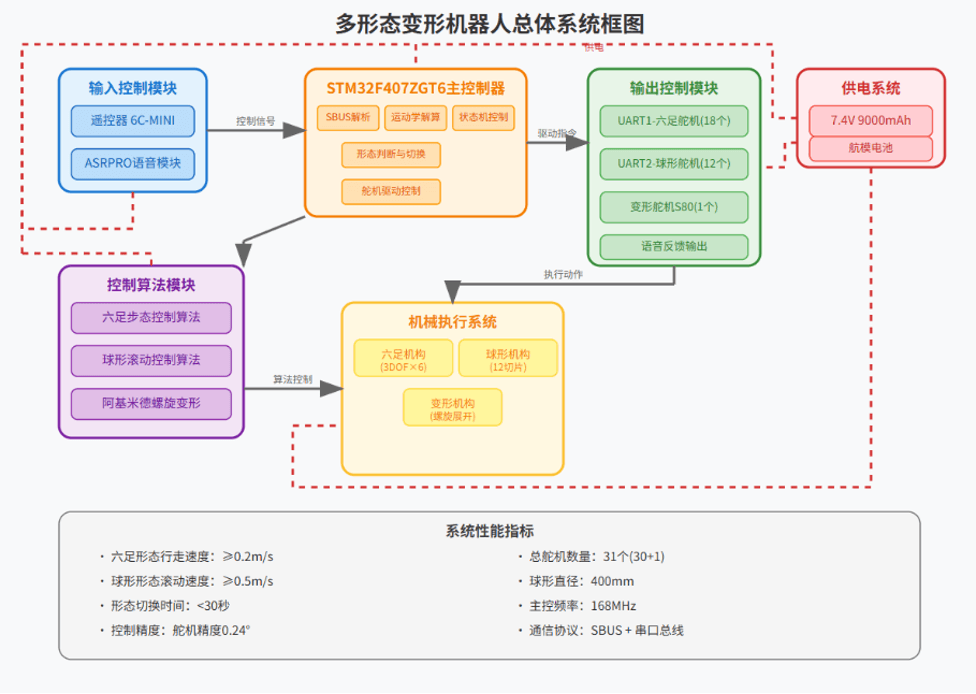
Main Control System: Uses the STM32F407ZGT6 microcontroller, with a main frequency of 168MHz, 1M Flash + 192K SRAM, and provides 6 UART interfaces to meet the communication needs of multiple servos. It integrates core algorithms such as kinematics calculations, gait control, and shape switching.
Drive System Circuit: Uses the AIP74HC126TA.TB quad three-state buffer to achieve level conversion and drive enhancement of serial signals. 30 ZX20D bus servos are responsible for leg movement and slice control, and 1 S80 servo is dedicated to driving the transformation mechanism to meet the high torque transformation requirements.
Transformation Mechanism Design: The core uses a chassis expansion mechanism designed based on the Archimedean spiral principle. Through the axial rotation of spiral slices driven by the gear system, it achieves synchronous expansion and contraction of the six legs, ensuring the stability and reliability of shape switching.
Communication System Circuit: Integrates the Microzone 6C-MINI remote control system, achieving 2.4GHz wireless control through the MC7RB-V2 receiver. The SBUS signal is processed by a hardware level inversion circuit before being connected to the main control. It also integrates the ASRPRO voice module, supporting offline voice recognition control.
Power Supply System: Uses a 7.4V/9000mAh/10C high-power model aircraft battery to meet the high power requirements in hexapod walking mode. It provides stable power supply to each module through the power management circuit on the PCB.
Software Code
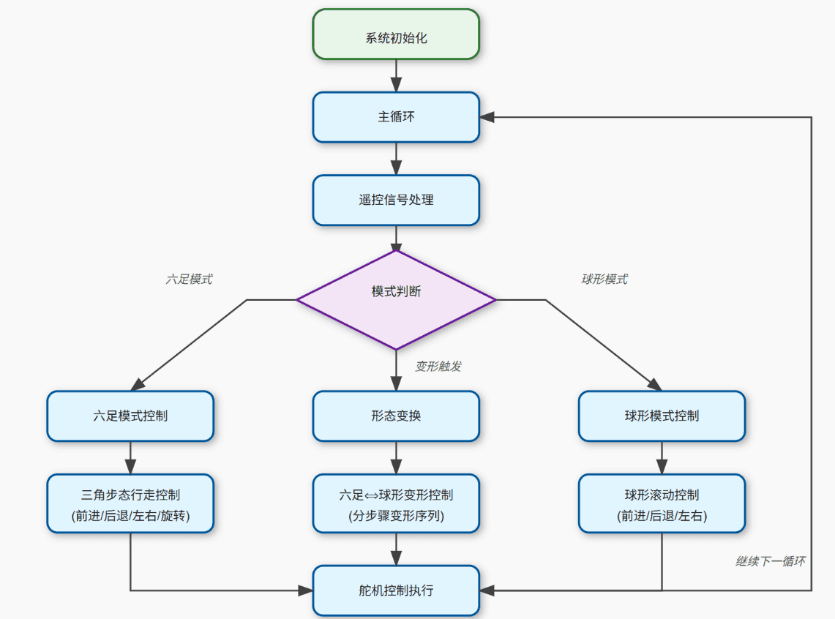
For the complete code, please refer to: (https://github.com/ZGPS-666/ZGPS_01 (opens in a new tab))
Notes
- Before starting any installation steps, complete the bus servo numbering and adjust them to the neutral position. Select mode one for the working mode and mode three for the power-on mode.
- Before starting any installation steps, set the central servo to the 30° position.
- The remote control needs to be paired with the receiver before use; pay attention to the level conversion of the SBUS signal.
- Charge the battery promptly when the voltage drops below 6.8V to avoid affecting the performance of the high-torque servos.
Assembly Process
To be updated
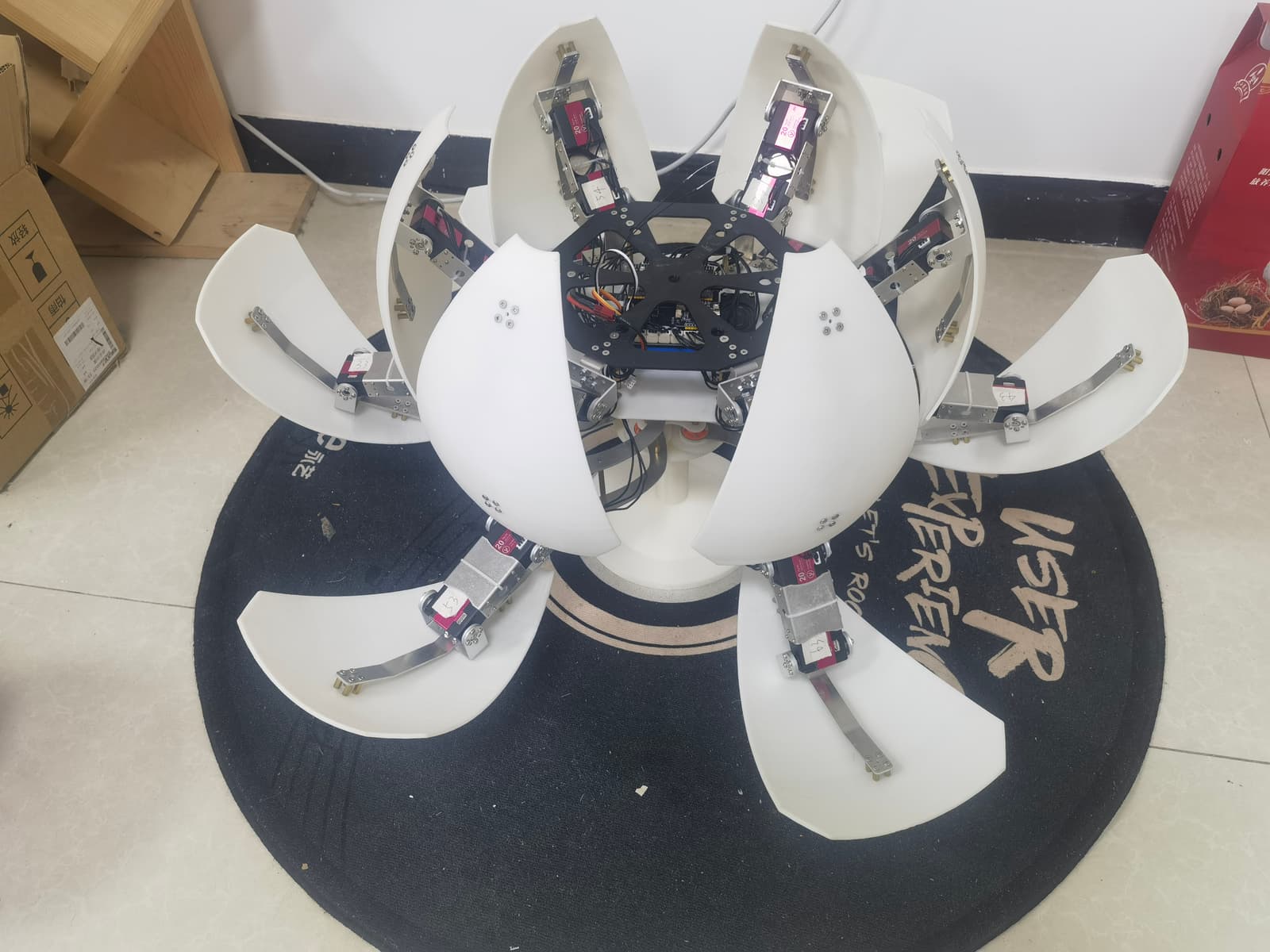
Physical Images
Figure 1: Hexapod Mode – The robot in its fully extended hexapod walking state
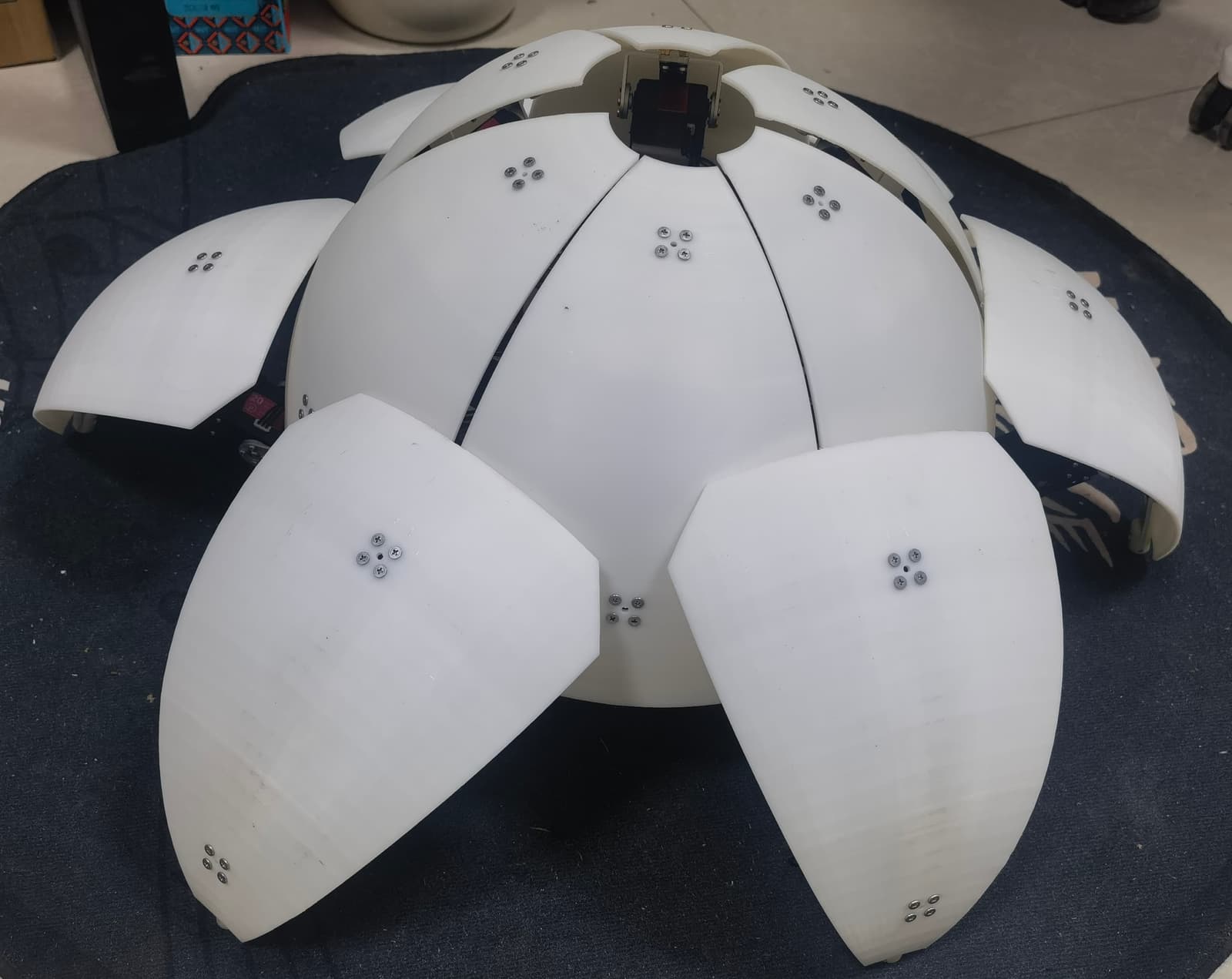
Figure 2: Ball Mode – The robot in its contracted rolling ball state
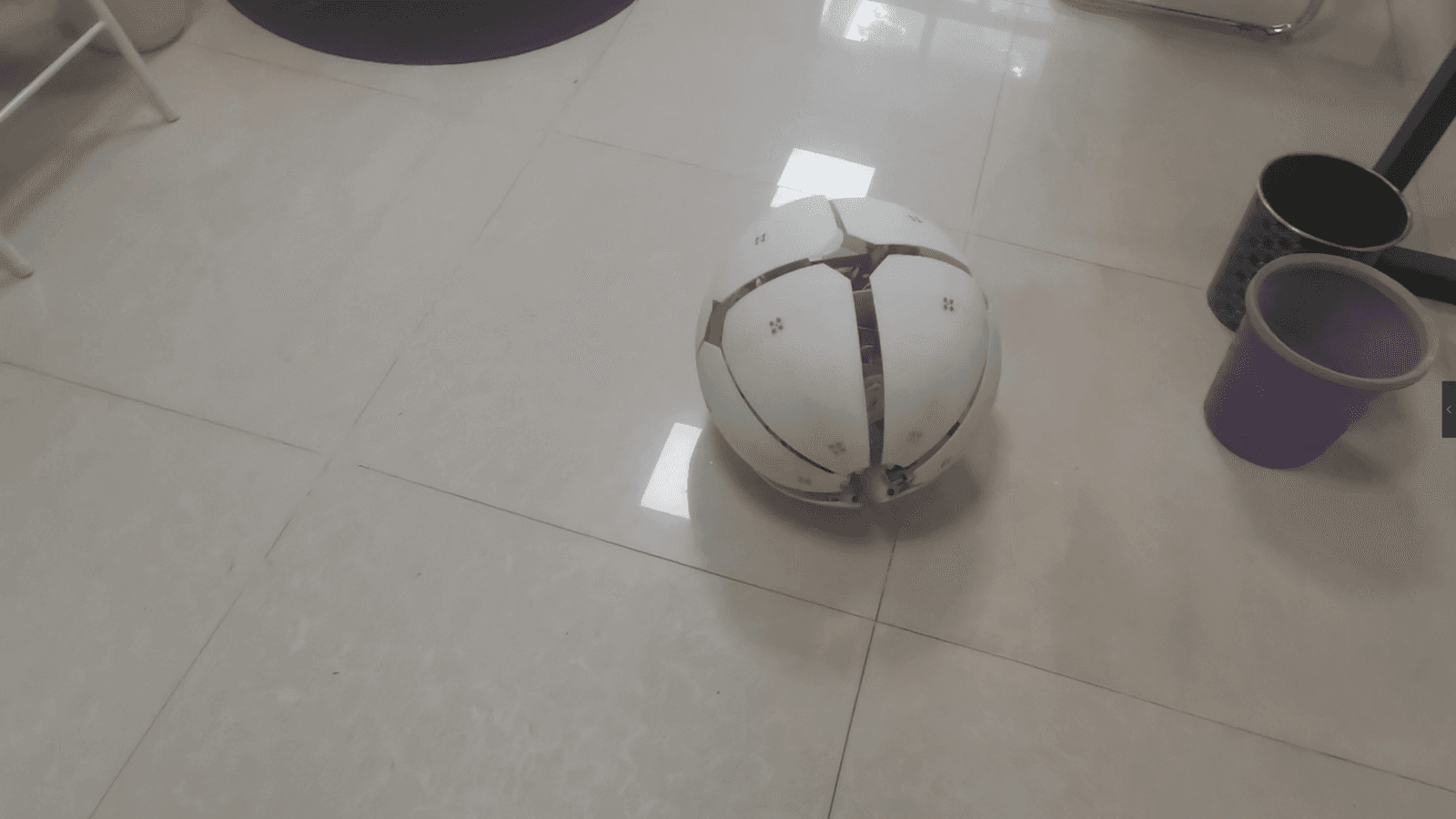
Figure 3: Demonstration Mode – An intermediate state during the transition from hexapod to ball mode
Disclaimer
Due to my limited skills, this being my first independent completion of a full project, and the tight timeline, I have only implemented the basic functions of the robot. The code is already showing signs of becoming a tangled mess, so this project can only guarantee that the robot can move.
Files by @ZGPS-666, at commit 2970e95, read from GitHub in your browser. Hardware license: GPL-3.0-only; software license: GPL-3.0-only. Robotheca doesn't review code: read it before running it.