Robotling 2
A small, simple six-legged robot with a tripod walk, driven by three servo motors and built with 3D printed parts and an RP2040 controller.
- Other
- Open source
- micropython
- 3D printable
Suggested by Robotheca, created by @teuler (opens in a new tab), from github.com/teuler/robotling2 (opens in a new tab). Pinned to commit a3dff8d (opens in a new tab).
- Hardware license
- MIT (opens in a new tab)
- Software license
- MIT (opens in a new tab)
- Commercial use
- Allowed
Photo and 3D model
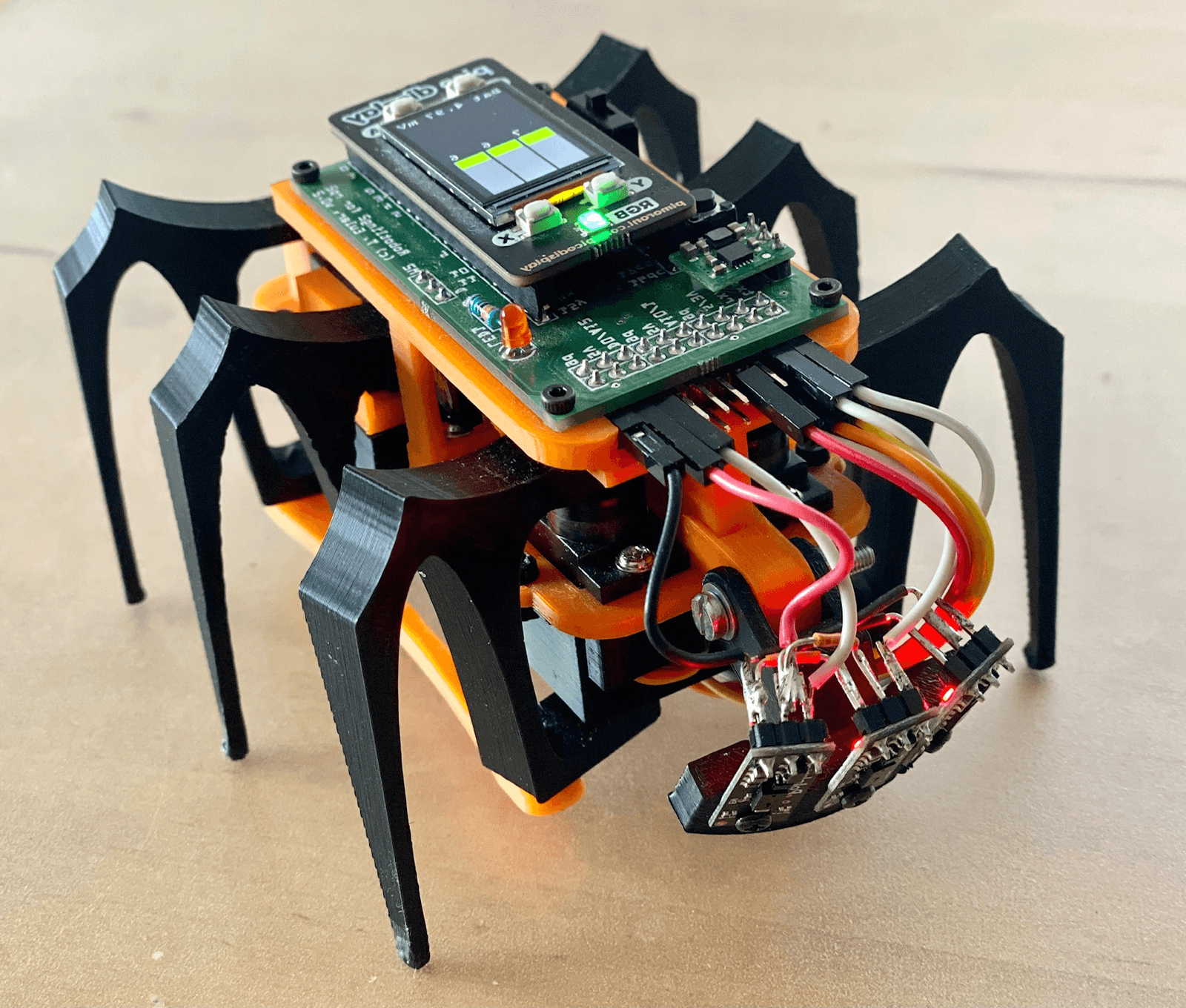
3D preview converted from github.com/teuler/robotling2 at a3dff8d, under MIT. View the original files from GitHub (1.9 MB) (opens in a new tab)
What it can do
Written by Robotheca from the project's documents.
- Six-legged walking robot that moves with a simplified tripod gait driven by only three servo motors.
- Walks around while avoiding obstacles and cliffs/edges, using time-of-flight distance sensors (MMBasic v1.12 version).
- Can back up to avoid an obstacle (MicroPython demo code).
- CO2 watchman version sleeps until CO2 concentration exceeds a limit, then wakes and walks; it also raises a display on a servo.
- Servo calibration programs are provided for adjusting leg positions.
- Mostly 3D printed; only electronics and a few screws are non-printed parts.
Bill of materials
This repository has no parts list Robotheca can read yet.
Build guide
The guide appears here as you scroll.
Guide by @teuler (README.md), under MIT.
More guides
Wiring and electronics
Notes written by Robotheca from the project's documents.
Main parts
- Raspberry Pi RP2040 microcontroller board (Pico) as the robot's brain.
- Three servo motors for leg movement; a fourth servo is used in the CO2 version to raise a display.
- Pololu time-of-flight distance sensors, or a Terabee Evo Mini ranging sensor, for obstacle detection.
- SCD41 CO2/temperature/humidity sensor in the CO2 watchman version.
- Display: PicoDisplay (240x135) or a 240x240 display in the CO2 version.
- Pololu voltage regulator (U3V16F5 replaces the discontinued U1V10F5) for power.
- Battery: a single-cell 1000 mAh LiPo, or 2x AAA cartridge (not recommended).
Connections
- Servo motors connect to the board's servo pins, with a constant defined for each sensor port pin in the MicroPython code.
- Time-of-flight sensors are connected to the board through sensor ports; the repository includes a wiring diagram (pictures/tof_wiring.png).
- The Pololu regulator's VIn and VOut pins are swapped compared with the older regulator, so it is not a simple drop-in replacement.
- Servo pin assignments are handled in one place at the end of the MMBasic program.
