Poppy Humanoid
An open-source, 3D printed humanoid robot designed for research and education, with modular parts for many applications and experiments.
- Humanoid
- Open source
- 3D model (URDF)
- 3D printable
Suggested by Robotheca, created by @poppy-project (opens in a new tab), from github.com/poppy-project/poppy-humanoid (opens in a new tab). Pinned to commit d66c8fb (opens in a new tab).
- Hardware license
- CC-BY-SA-4.0 (opens in a new tab)
- Software license
- GPL-3.0-only (opens in a new tab)
- Commercial use
- Allowed
Photo and 3D model
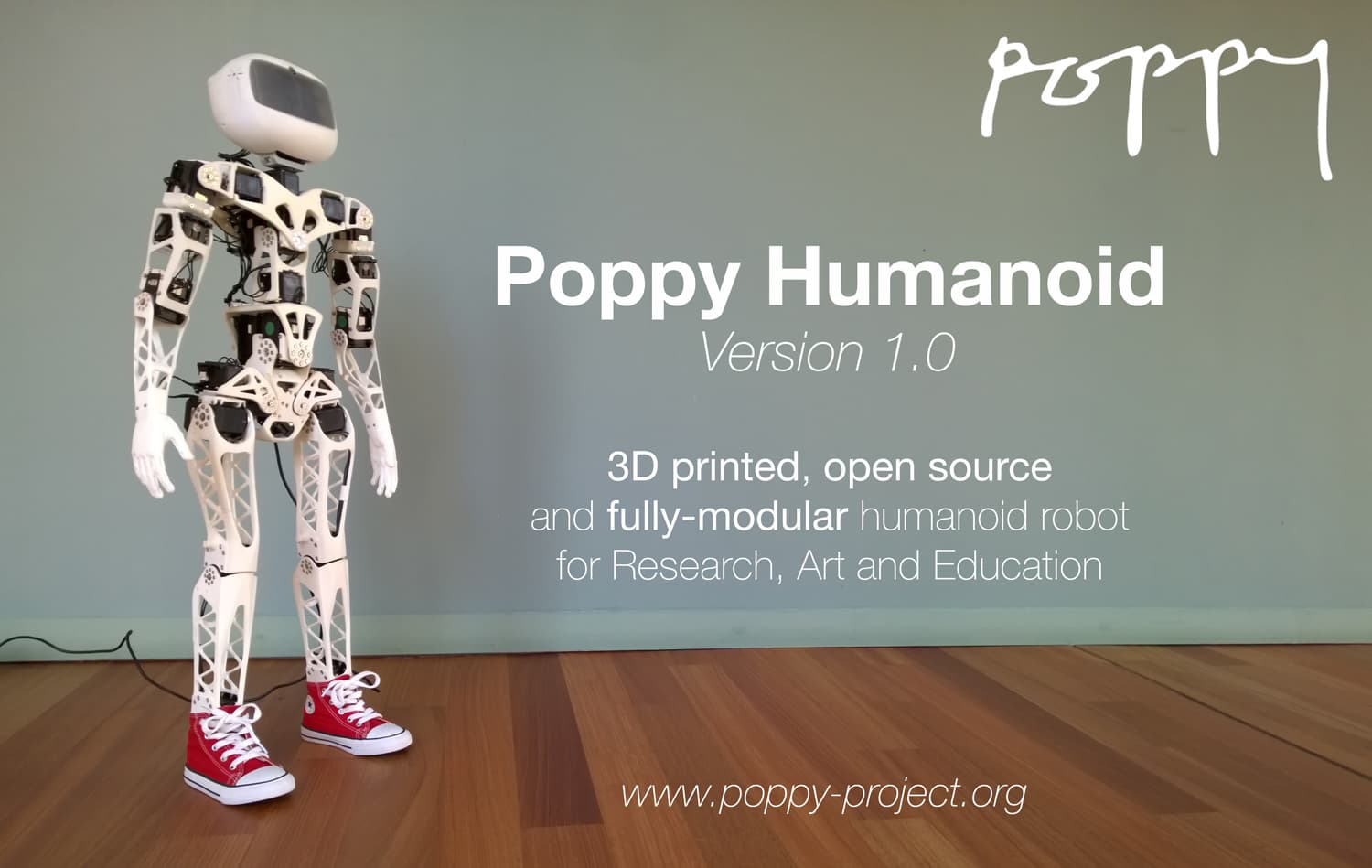
3D preview converted from github.com/poppy-project/poppy-humanoid at d66c8fb, under CC-BY-SA-4.0. View the original files from GitHub (6.0 MB) (opens in a new tab)
What it can do
Written by Robotheca from the project's documents.
- Poppy Humanoid is an open-source, 3D printed humanoid robot intended for research and education.
- Its modular design supports a wide range of applications and experiments.
- Its 25 Robotis Dynamixel actuators are its main motors, accounting for about 60% of the build cost.
Bill of materials
This repository has no parts list Robotheca can read yet.
Build guide
The creator's steps, each with its instructions.
- 1Assemble the complete Poppy Humanoid following the assembly instructions
The guide appears here as you scroll.
Guide by @poppy-project (README.md), under CC-BY-SA-4.0 (hardware) and GPL-3.0-only (software).
More guides
Wiring and electronics
Notes written by Robotheca from the project's documents.
Main parts
- A Raspberry Pi 3 or 4 serves as the embedded board that runs the robot.
- Robotis Dynamixel actuators, 25 of them, drive the robot's joints.
- A USB2Dynamixel or USB2AX adapter can connect the motors to a separate computer.
Connections
- The Dynamixel motors can be connected directly to a computer through a USB2Dynamixel or USB2AX adapter instead of the embedded board.