RoBart
An autonomous hoverboard-based mobile robot controlled by an iPhone Pro running LLM agents for navigation and voice tasks.
- Home
- Open source
- Works with AI
- arduino
- 3D printable
Suggested by Robotheca, created by @trzy (opens in a new tab), from github.com/trzy/RoBart (opens in a new tab). Pinned to commit be740c2 (opens in a new tab).
- Hardware license
- GPL-3.0-only (opens in a new tab)
- Software license
- GPL-3.0-only (opens in a new tab)
- Commercial use
- Allowed
Photo and 3D model
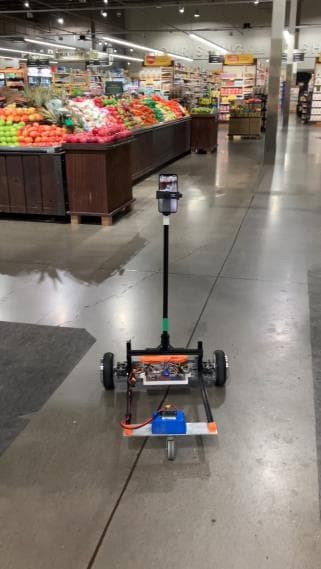
3D preview converted from github.com/trzy/RoBart at be740c2, under GPL-3.0-only. View the original files from GitHub (2.5 MB) (opens in a new tab)
What it can do
Written by Robotheca from the project's documents.
- Drives a salvaged hoverboard base autonomously using an iPhone Pro for compute, sensors, and ARKit SLAM mapping.
- Runs an LLM agent (Claude or GPT-4) that listens to speech, plans, and completes tasks using robot actions.
- Executes motion commands such as drive, rotate in place, drive forward by distance, and drive to a world position.
- Builds an occupancy map from scene meshing and annotates photos with navigable points for the agent.
- Can be commanded by voice through the iPhone or an optional Apple Watch microphone, and by a debug server or teleoperation client.
Works with AI
Found by Robotheca in the project's files at commit be740c2, its robot.yaml and Robotheca's notes on its documents. Never guessed; Robotheca doesn't run the code.
Uses a language model: Anthropic
In the project files: ios/RoBart/RoBart/Brain/Anthropic.swift“Runs an LLM agent (Claude or GPT-4) that listens to speech, plans, and completes tasks using robot actions.”
Robotheca's notes: What it can do“Enter an LLM API key and a Deepgram API key in the app settings view, since transcription uses Deepgram.”
Robotheca's notes: How to run it
Bill of materials
This repository has no parts list Robotheca can read yet.
Build guide
The guide appears here as you scroll.
Guide by @trzy (README.md), under GPL-3.0-only.
Wiring and electronics
Notes written by Robotheca from the project's documents.
Main parts
- Apple iPhone Pro running the iOS app, providing compute, camera, LiDAR, and microphone.
- Adafruit Feather nRF52 Bluefruit LE board controlling the motors over Bluetooth Low Energy.
- Two RioRand 350W brushless DC motor drivers driving the hoverboard motors.
- DC-DC converter stepping the 36V battery voltage down to 3.3V for the Feather board.
- Hoverboard battery pack, with XT60 splitter cables routing battery power.
Connections
- Dupont connectors link the motor driver boards to the Feather board.
- Motors connect to the driver boards through connectors.
- Battery power is routed through XT60 splitter cables and reduced to 3.3V by the DC-DC converter for the Feather.


