Modular Biped
An open-source, 3D printable, modular bipedal companion robot with articulated legs, Arduino and Raspberry Pi control, and a configurable software framework.
- Humanoid
- Open source
- Works with AI
- 3D printable
Suggested by Robotheca, created by @makerforgetech (opens in a new tab), from github.com/makerforgetech/modular-biped (opens in a new tab). Pinned to commit 5eb1866 (opens in a new tab).
- Hardware license
- GPL-3.0-only (opens in a new tab)
- Software license
- GPL-3.0-only (opens in a new tab)
- Commercial use
- Allowed
This repository contains executable files that Robotheca doesn't check. Only run them if you trust the creator.
Which files (5 scripts, 1 program or installer)
Photo and 3D model
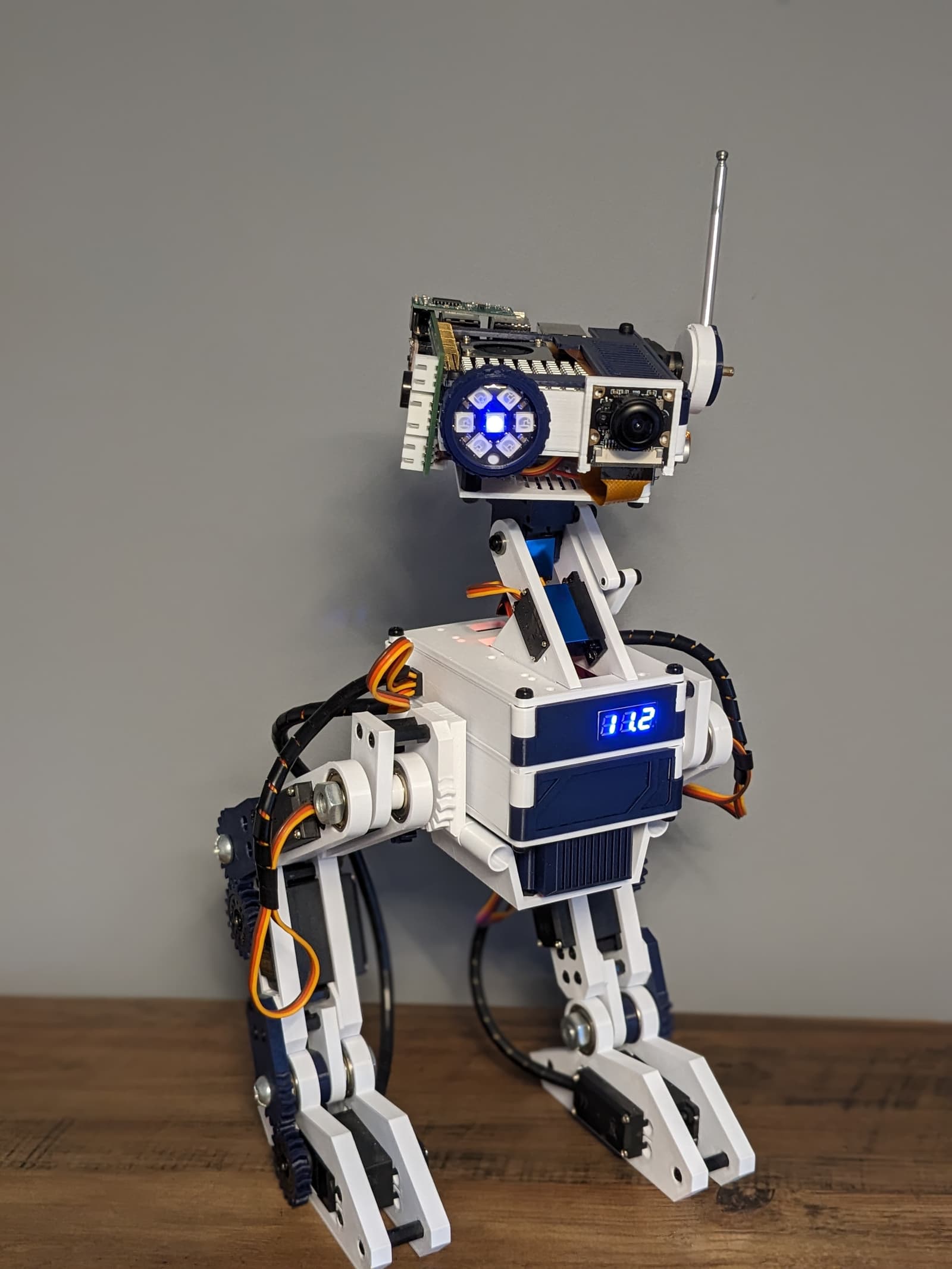
3D preview converted from github.com/makerforgetech/modular-biped at 5eb1866, under GPL-3.0-only. View the original files from GitHub (3.2 MB) (opens in a new tab)
What it can do
Written by Robotheca from the project's documents.
- Articulated legs give the robot bipedal walking and turning movements, handled by the Animation module.
- Text-to-speech output through an onboard speaker.
- Braille-based speech output using the onboard buzzer.
- Plays tones and melodies through the onboard buzzer.
- Processes user text with OpenAI GPT models (ChatGPT module).
- Detects motion with an onboard microwave motion sensor.
- Gives visual feedback with onboard Neopixel LEDs.
- Tracks objects and faces with computer vision using the onboard camera.
Works with AI
Found by Robotheca in the project's files at commit 5eb1866, its robot.yaml and Robotheca's notes on its documents. Never guessed; Robotheca doesn't run the code.
Ships trained model files: mobilenet_v1_1.0_224_l2norm_quant_edgetpu.tflite and 5 more
In the project files: modules/archived/coral/models/mobilenet_v1_1.0_224_l2norm_quant_edgetpu.tfliteUses a language model: ChatGPT
In the project files: config/chatgpt.ymlUses a machine-learning library: TensorFlow
In the project files: modules/archived/scripts/tensorflow_install.sh“Processes user text with OpenAI GPT models (ChatGPT module).”
Robotheca's notes: What it can do
Bill of materials
This repository has no parts list Robotheca can read yet.
Build guide
The guide appears here as you scroll.
Guide by @makerforgetech (README.md), under GPL-3.0-only.
Wiring and electronics
Notes written by Robotheca from the project's documents.
Main parts
- Arduino board for servo control, managed through custom PCBs.
- Raspberry Pi as the main computer.
- Servos for the legs and joints.
- Onboard buzzer for audio output.
- Onboard speaker for speech.
- Neopixel LEDs.
- Microwave motion sensor.
- IMX500 Raspberry Pi AI camera.
- RTL-SDR dongle for radio reception.
- Integrated temperature sensor on the Raspberry Pi.
Connections
- The Raspberry Pi and Arduino communicate over a serial connection.
- The Raspberry Pi drives the servos connected to it directly, and the Arduino drives the servos connected to it.
- Custom PCBs in several revisions (v2, v3, v4) hold the Upper, Lower, Head and Body boards.
- The v4 Head board has a schematic document in the repository showing its connections.
Schematics, boards and diagrams
- circuits/v2/Lower/Gerber.zipGerber (PCB manufacturing)
- circuits/v2/Lower/GerberGerber (PCB manufacturing)
- circuits/v2/Lower/Lower Feb 2021.fzzFritzing
- circuits/v2/Upper/Gerber.zipGerber (PCB manufacturing)
- circuits/v2/Upper/GerberGerber (PCB manufacturing)
- circuits/v2/Upper/Top Feb 2021.fzzFritzing
- circuits/v3/archiveGerber (PCB manufacturing)
- circuits/v3/archive/v3_1Gerber (PCB manufacturing)
- circuits/v3/bodyGerber (PCB manufacturing)
- circuits/v3/body/body.fzzFritzing
- circuits/v3/head/Gerber.zipGerber (PCB manufacturing)
- circuits/v3/head/GerberGerber (PCB manufacturing)
- circuits/v3/head/head.fzzFritzing
- circuits/v4/Head/head_schematic.pdfDiagram
- circuits/v4/Head/head_schematic.pngDiagram
- circuits/v4/Head/v4head/GerberGerber (PCB manufacturing)
- circuits/v4/Head/v4head/v4head.kicad_pcbKiCad
- circuits/v4/Head/v4head/v4head.kicad_schKiCad
