Hand Exoskeleton
A low-cost 6DoF hand exoskeleton using linkage and tendon mechanisms, controlled by an ESP32 and seven SC09 bus servos.
- Robot arm
- Open source
- arduino
- 3D printable
Suggested by Robotheca, created by @MengyangGao (opens in a new tab), from github.com/MengyangGao/hand_exoskeleton (opens in a new tab). Pinned to commit a5d6a1d (opens in a new tab).
- Hardware license
- MIT (opens in a new tab)
- Software license
- MIT (opens in a new tab)
- Commercial use
- Allowed
Photo and 3D model
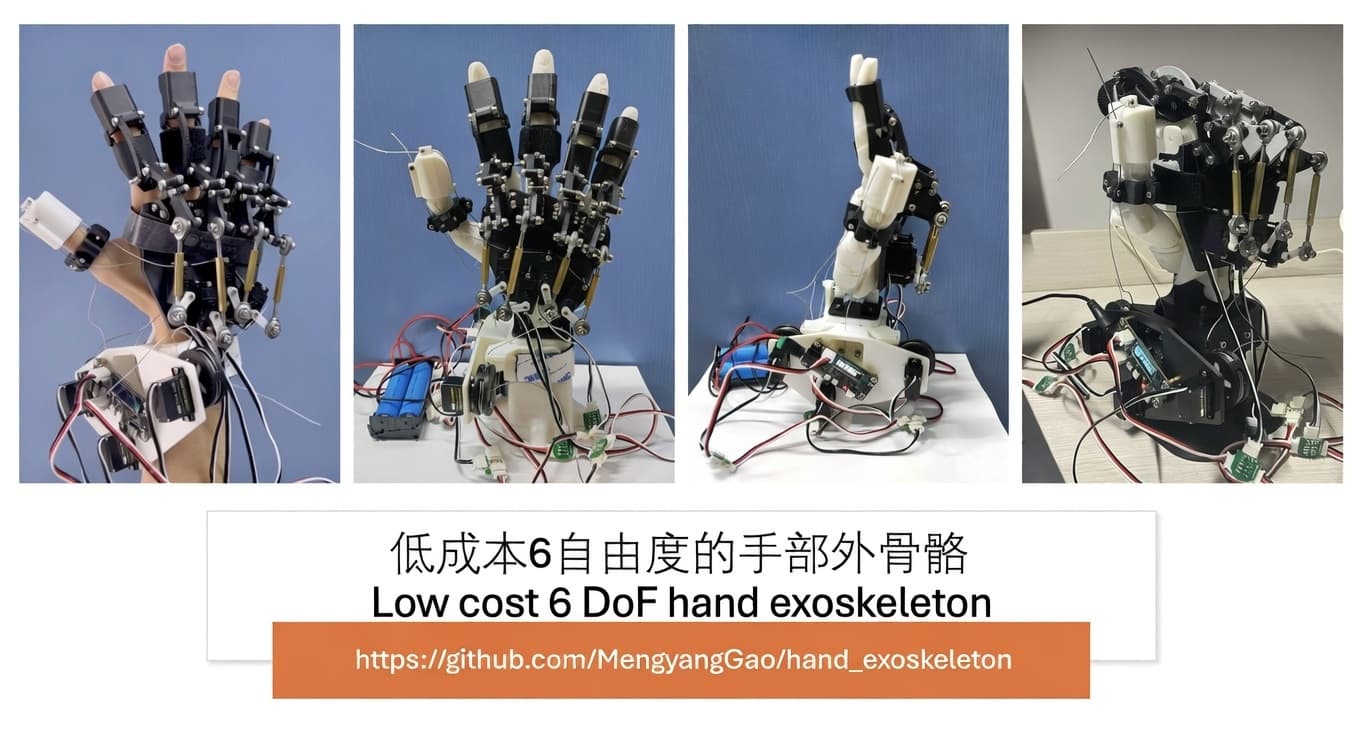
3D preview converted from github.com/MengyangGao/hand_exoskeleton at a5d6a1d, under MIT. View the original files from GitHub (7.8 MB) (opens in a new tab)
- Degrees of freedom
- 6
- Weight
- 400 g
- Height
- 310 mm
What it can do
Written by Robotheca from the project's documents.
- 6-degree-of-freedom hand exoskeleton movement
- Controlled via Wi-Fi web interface
- Supports Bluetooth, Wi-Fi and ESP-NOW communication
- Predefined hand gestures like open, close and rock-paper-scissors
- Single-servo control via serial commands
- Multi-servo synchronized movement
- Adjustable movement speed
Bill of materials
This repository has no parts list Robotheca can read yet.
Build guide
The creator's steps, each with its instructions.
- 1Download and prepare repository files
- 23D print mechanical parts
- 3Assemble mechanical structure
- 4Configure ESP32 Arduino development environment
- 5Upload software to ESP32
- 6Set servo IDs via web interface
- 7Calibrate mechanical zero positions
- 8Test and operate
The guide appears here as you scroll.
Guide by @MengyangGao (README.md), under MIT. The English translation is by Robotheca, shared under the same license.
Wiring and electronics
Notes written by Robotheca from the project's documents.
Main parts
- ESP32 microcontroller
- 7 SC09 serial bus servos
- Servo Driver with ESP32 expansion board
- 8 M3 eyelet bearings
- 0.8 mm steel wire for tendon drive
- 5.5×2.1 mm DC power input
- Type-C programming port
Connections
- SC09 servos connected in serial bus to ESP32 expansion board
- Servo power and signal lines shared on bus
- Steel wire routed through linkage for thumb tendon drive
- ESP32 expansion board powered at 6–12 V DC