EquiCycle
An autonomous self-balancing bicycle robot designed for outdoor track racing, featuring lane detection, obstacle recognition, and balance control algorithms.
- Self-driving 1:10
- Open source
- Works with AI
- ROS
- 3D printable
Suggested by Robotheca, created by @Ashington258 (opens in a new tab), from github.com/Ashington258/EquiCycle (opens in a new tab). Pinned to commit e542f7f (opens in a new tab).
- Hardware license
- MIT (opens in a new tab)
- Software license
- MIT (opens in a new tab)
- Commercial use
- Allowed
This repository contains executable files that Robotheca doesn't check. Only run them if you trust the creator.
Which files (1 script)
Photo and 3D model
3D preview converted from github.com/Ashington258/EquiCycle at e542f7f, under MIT. View the original files from GitHub (6.3 MB) (opens in a new tab)
What it can do
Written by Robotheca from the project's documents.
- Balances itself while moving forward, backward or turning
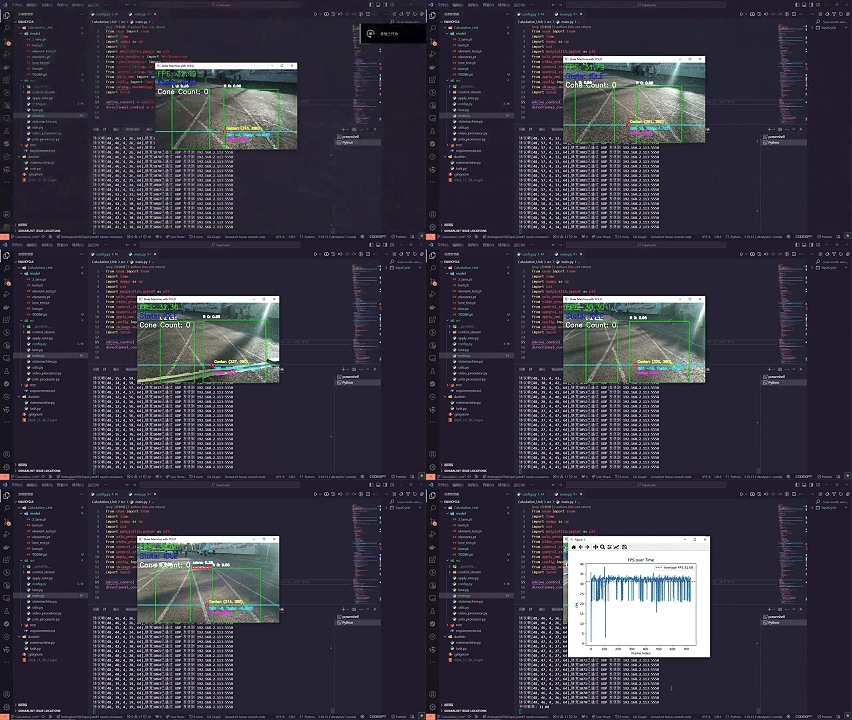
- Follows lane lines autonomously
- Detects obstacles and avoids them
- Can be controlled by remote control or keyboard
- Uses PID or LQR control algorithms for balance and motion
Works with AI
Found by Robotheca in the project's files at commit e542f7f, its robot.yaml and Robotheca's notes on its documents. Never guessed; Robotheca doesn't run the code.
Ships trained model files: 2_lane.pt and 7 more
In the project files: Calculation_Unit/model/2_lane.ptUses computer vision: YOLO
In the project files: Calculation_Unit/src/yolo_processor.py
Bill of materials
This repository has no parts list Robotheca can read yet.
Build guide
The creator's steps, each with its instructions.
- 1Prepare 3D printable parts
- 2Assemble mechanical structure
- 3Install control and calculation units
- 4Calibrate balance and motion control algorithms
- 5Test vision and obstacle detection
- 6Perform field tests
The guide appears here as you scroll.
Guide by @Ashington258 (README.md), under MIT. The English translation is by Robotheca, shared under the same license.
Wiring and electronics
Notes written by Robotheca from the project's documents.
Main parts
- Raspberry Pi 4 as the main controller
- IMU sensor for balance feedback
- Camera for lane line detection and obstacle recognition
- Motor drivers for left and right wheels
- Battery pack for power supply
Connections
- IMU sensor connects to Raspberry Pi 4 via I2C
- Camera connects to Raspberry Pi 4 via USB