Project files
5 KB
Machine-translated by Robotheca from the original in Chinese (opens in a new tab). License: CC-BY-SA-4.0 (opens in a new tab).
Open-Source Wheeled Combat Robot Mechanical Structure
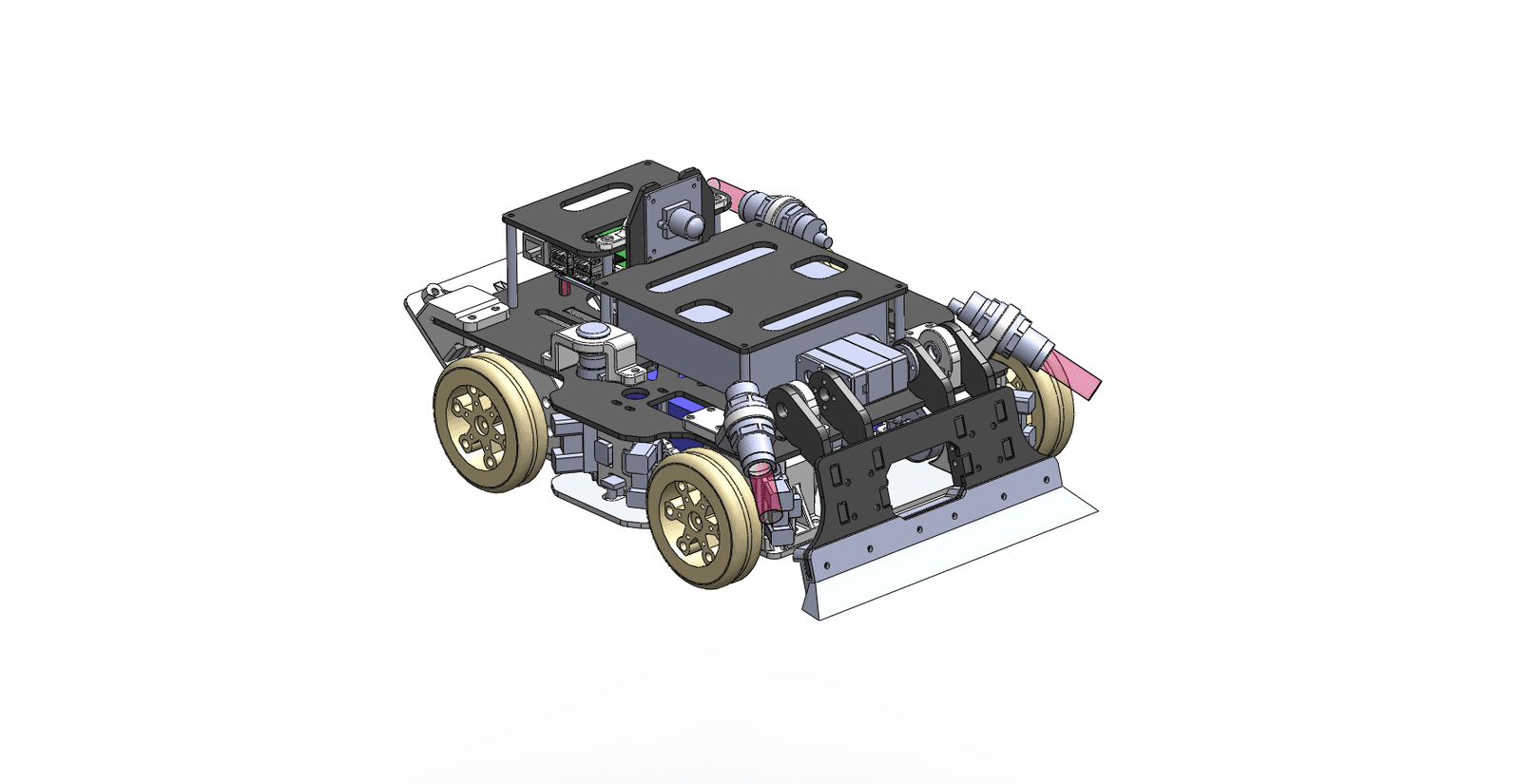
This is a 3.5kg wheeled combat robot project based on STM32 + Raspberry Pi. All mechanical structures are now open-source, aiming to provide reference and communication for participants and combat robot enthusiasts.
📥 Model Download
Since the SolidWorks engineering files are large, we host the source files on a cloud drive, with GitHub serving only as the documentation and BOM table maintenance platform.
- Download link: Baidu Netdisk (opens in a new tab)
- Extraction code:
2233 - Files included:
- Complete assembly source files (SolidWorks 2023)
- Universal format files (
.STEP) for viewing in older versions or other software
- ⚠️ Note: The source files are designed in SolidWorks 2023. Lower-version software cannot directly open SLDPRT/SLDASM files. Please use the STEP format or upgrade your software.
⚙️ Technical Specifications
- Weight: approximately 3500g (3.5kg class)
- Overall dimensions: 290 × 230 × 145 mm
- Design software: SolidWorks 2023
- Power system:
- Drive: 4WD differential steering, JGB37-3625 brushless DC geared motor (24V) × 4
- Weapon: 15kg dual-axis servo-driven shovel structure
- Battery: Qisom 24V 12A lithium battery pack
- Sensing system (Sensors):
- Grayscale sensors × 4 (identify arena grayscale values)
- Infrared distance sensors × 6~12 (detect barriers, steps, energy blocks, and opponents)
- Photoelectric switches × 3 (edge detection × 2 + orientation detection below the arena × 1)
- IMU: angle sensor (attitude detection)
🛠️ Bill of Materials (BOM)
Core Electronic Components
| Component | Model/Specification | Notes |
|---|---|---|
| Host Computer | Raspberry Pi 5 | Handles vision and decision-making |
| Slave Computer | STM32H743VGT5 | Handles motion control |
| Drive Motor | JGB37-3625 (24V) | Brushless geared motor |
| Weapon Servo | 15kg Dual-Axis Digital Servo | Lifts the shovel at startup to prevent size limit issues |
Structural Materials
- Base plate: Sheet metal bending
- Body panels: FR-4 fiberglass board (high strength, insulating)
- 3D-printed parts: PLA material (recommended upgrade to PLA+ or PETG for improved impact resistance)
📋 For the complete Excel BOM table and purchase links, see the
/bomdirectory in the repository.
🔧 Manufacturing and Assembly Recommendations
-
Material Selection: The original machine uses PLA printing, which may not provide sufficient strength in actual combat. If possible, use Nylon sintering or PETG printing for core load-bearing components.
-
Outsourced Processing: For sheet metal and fiberglass plates, it is recommended to export the CAD drawings directly and have them processed by Taobao sellers for better precision.
-
Assembly Recommendations:
- For high-stress screws (e.g., motor mounts, weapon shafts), use medium-strength thread locker (blue) to prevent loosening due to vibration.
- Pay attention to the assembly sequence; otherwise, you may end up in an awkward situation where the outer shell is installed but the inner screws cannot be tightened.
- Leave space for wire channels: Since internal wiring is dense, be sure to use zip ties to organize the wires during assembly to prevent wear.
⚠️ Iterations and Optimizations (Known Issues & Optimization)
This project is the first-generation prototype (V1.0). The following issues were identified during practical use and debugging. Please be sure to optimize when replicating:
- Difficulty turning: The high-friction wheels create significant resistance when turning. (Can be alleviated by reducing the wheelbase and increasing the track width.)
- Motor durability: The original motor shafts are prone to loosening or breaking under impact (2 were damaged during competitions). We strongly advise against using the same motor model.
- Difficulty in maintenance: Insufficient consideration for quick repairs; replacing the battery or motor requires removing numerous screws and wiring harnesses.
- Limited installation space: Some areas are inaccessible with wrenches.
- Battery mounting: Lack of dedicated battery tie-down holes.
- Poor wiring: Wiring was not considered in the design, leading to exposed and chaotic wiring that is unreliable.
🏟️ Supporting Facilities
If you want to set up a standard test environment, you can use our open-source supporting arena: 👉 Click to jump: Low-cost Combat Robot Arena Project (opens in a new tab)
🛑 Safety Warnings
- Combat robots carry certain risks. Please ensure your own safety when debugging motors and weapons.
- The author is not responsible for any property damage or personal injury caused by assembling, modifying, or using this project.
📜 Open Source License
This project is open-sourced under the CC BY-SA 4.0 license. You are free to modify and distribute it, but you must retain the original author's attribution, and any modified works must be open-sourced under the same license.
📬 Communication and Feedback
- Bilibili: mcal (opens in a new tab)
- Email: 1905360479@qq.com (opens in a new tab)
- Discussion Group: 996144753 (opens in a new tab)
❤️ Summary and Prospects
This is a record of a small project I worked on during that abstract final exam week. Although I didn't achieve a satisfactory grade in the end, I still learned a lot from the process.
Special Thanks
- Thanks to Xiaowen and Xiaoqiang for debugging with me all night;
- Thanks to Xiaomu for helping me set up the arena;
- Thanks to Teacher Lu and Teacher Gao for providing funding and venue support.
About Open Source
When we were working on this before, there were few open-source resources online, and many things couldn't be copied directly, so we had to test them ourselves. This time, we are open-sourcing it in the hope of providing some reference for future participants.
We hope that later generations can continue to improve it on this basis. If you have new ideas or suggestions, feel free to discuss them with us.
Files by @waodfi, at commit 44acbb0, read from GitHub in your browser. Hardware license: CC-BY-SA-4.0; software license: CC-BY-SA-4.0. Robotheca doesn't review code: read it before running it.