CE2T 6-DOF Robotic Arm
A budget-friendly, mainly 3D-printed 6-degree-of-freedom robotic arm driven by stepper motors and controlled by an Arduino in open loop.
- Robot arm
- Open source
- arduino
- 3D printable
Suggested by Robotheca, created by @Gavinkuo123456 (opens in a new tab), from github.com/Gavinkuo123456/CE2T-6-Axis-Robotic-Arm (opens in a new tab). Pinned to commit 0138353 (opens in a new tab).
- Hardware license
- MIT (opens in a new tab)
- Software license
- MIT (opens in a new tab)
- Commercial use
- Allowed
Photo and 3D model
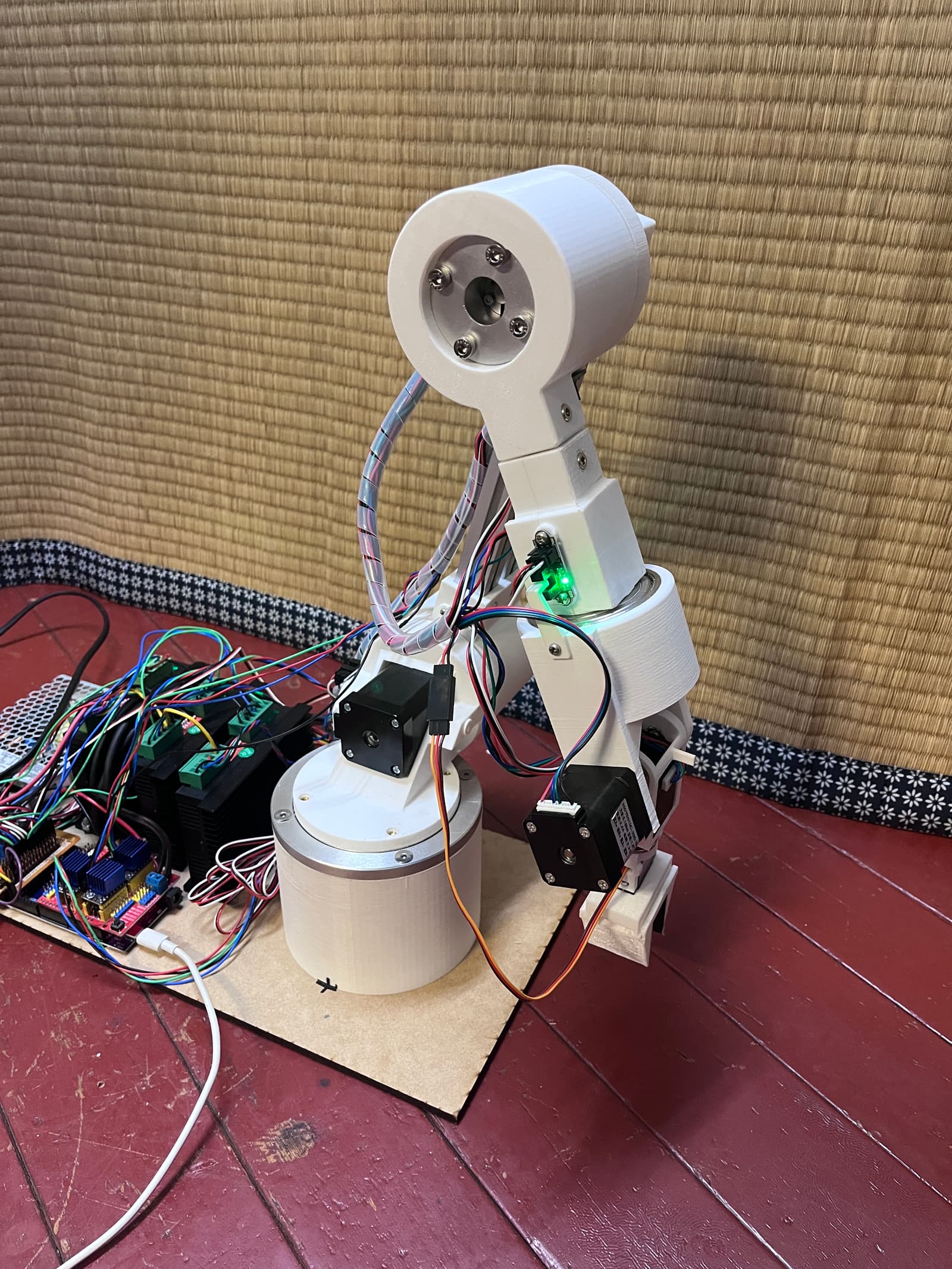
3D preview converted from github.com/Gavinkuo123456/CE2T-6-Axis-Robotic-Arm at 0138353, under MIT. View the original files from GitHub (2.6 MB) (opens in a new tab)
- Degrees of freedom
- 6
- Reach
- 500 mm
- Payload
- 500 g
What it can do
Written by Robotheca from the project's documents.
- Controls a 6-degree-of-freedom arm with open-loop stepper motor positioning
- Accepts joint-angle moves, Cartesian inverse-kinematics moves, homing and gripper commands over serial
- Can also receive position commands over I2C from another device
- Uses Denavit-Hartenberg forward and inverse kinematics for position control
- Rated payload about 500g and workspace about 500mm radius, per the documents
Bill of materials
This repository has no parts list Robotheca can read yet.
Build guide
The guide appears here as you scroll.
Guide by @Gavinkuo123456 (README.md), under MIT.
Wiring and electronics
Notes written by Robotheca from the project's documents.
Main parts
- Arduino Due controller board
- TMC2209 and DM542 stepper motor drivers
- Stepper motors: NEMA23, NEMA17 (two with planetary gearboxes), NEMA14 and NEMA11 for the six joints
- 24V 100W power supply
- Six optical endstop limit switches
- Pin header and a general-purpose PCB as a custom expansion board
Connections
- Motor drivers connect each stepper motor to the Arduino Due controller
- Power for the drivers and motors comes from the 24V 100W supply
- Limit switches are wired as optical endstops, one per joint, to the controller
- Serial and I2C interfaces are available for sending commands to the controller