BOTZO
An open-source autonomous quadruped robot dog designed to navigate and interact with its environment.
- Quadruped
- Open source
- Work in progress
- Works with AI
- ROS 2
- 3D model (URDF)
- 3D printable
Suggested by Robotheca, created by @IERoboticsAILab (opens in a new tab), from github.com/IERoboticsAILab/botzo (opens in a new tab). Pinned to commit 6a35f2a (opens in a new tab).
- Hardware license
- Apache-2.0 (opens in a new tab)
- Software license
- Apache-2.0 (opens in a new tab)
- Commercial use
- Allowed
This repository contains executable files that Robotheca doesn't check. Only run them if you trust the creator.
Which files (1 script)
Photo and 3D model
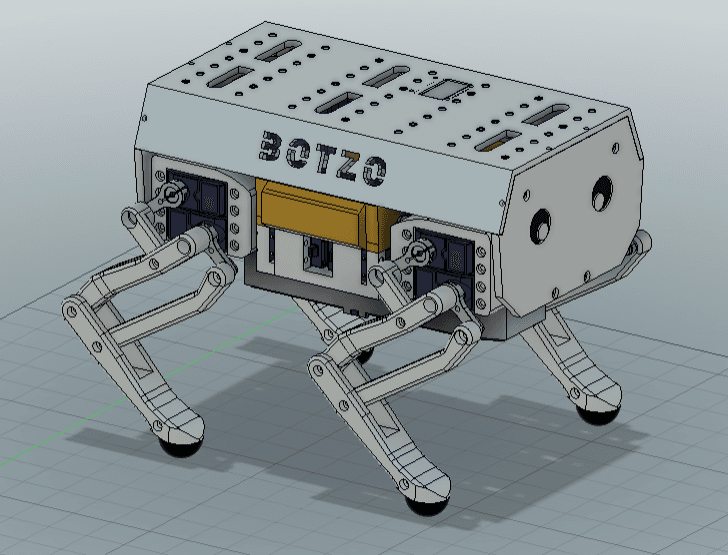
3D preview converted from github.com/IERoboticsAILab/botzo at 6a35f2a, under Apache-2.0. View the original files from GitHub (13.1 MB) (opens in a new tab)
What it can do
Written by Robotheca from the project's documents.
- Botzo is described as an autonomous quadruped robot meant to navigate and interact with its environment.
- The platform aims to navigate complex terrains, collect data and samples, and interact with its environment.
- Locomotion is intended to be learned via reinforcement learning, with inverse kinematics already modelled.
- A PyBullet simulation of the robot exists for development.
Works with AI
Found by Robotheca in the project's files at commit 6a35f2a, its robot.yaml and Robotheca's notes on its documents. Never guessed; Robotheca doesn't run the code.
Uses reinforcement learning
In the project files: simulation/reinforcement_learning“Locomotion is intended to be learned via reinforcement learning, with inverse kinematics already modelled.”
Robotheca's notes: What it can do
Bill of materials
This repository has no parts list Robotheca can read yet.
Build guide
The guide appears here as you scroll.
Guide by @IERoboticsAILab (README.md), under Apache-2.0.
More guides
Wiring and electronics
Notes written by Robotheca from the project's documents.
Main parts
- The documents mention circuit sketches (basic and full) but do not name specific controller boards, motors, or sensors.
- The firmware folder contains Arduino and C code, implying microcontroller boards, though the parts are not named in the text.
Connections
- Circuit sketches for the robot exist in the repository, but the written documents do not describe the connections.

