Agrofelis Agricultural Robot
A low-cost, energy-dense four-wheel-drive agricultural base vehicle that carries implements such as a thermal fogger for orchard and vineyard work.
- Wheeled
- Open source
- Works with AI
- arduino
- 3D printable
Suggested by Robotheca, created by @meltoner (opens in a new tab), from github.com/meltoner/agrofelis (opens in a new tab). Pinned to commit 3a2ec90 (opens in a new tab).
- Hardware license
- MIT (opens in a new tab)
- Software license
- MIT (opens in a new tab)
- Commercial use
- Allowed
This repository contains executable files that Robotheca doesn't check. Only run them if you trust the creator.
Which files (15 scripts, 10 firmware images)
- components/connectivity/src/agrofelis-unificator/docker/00.createNetwork.sh (opens in a new tab)
- components/connectivity/src/agrofelis-unificator/docker/01.init.agrofelis.unificator.sh (opens in a new tab)
- components/connectivity/src/agrofelis-unificator/docker/02.init.agrofelis.os.sh (opens in a new tab)
- components/connectivity/src/agrofelis-unificator/docker/03.agrofelis.arduino.compile.sh (opens in a new tab)
- components/connectivity/src/agrofelis-unificator/docker/04.init.agrofelis.os.R.sh (opens in a new tab)
- components/connectivity/src/agrofelis-unificator/docker/10.autostart.agrofelis.unificator.sh (opens in a new tab)
- components/connectivity/src/agrofelis-unificator/docker/20.init.nginx.sh (opens in a new tab)
- components/connectivity/src/agrofelis-unificator/docker/images/01.build.agrofelis.os.sh (opens in a new tab)
- components/connectivity/src/agrofelis-unificator/docker/images/01.build.agrofelis.unificator.sh (opens in a new tab)
- components/connectivity/src/agrofelis-unificator/docker/images/02.build.agrofelis.os.R.sh (opens in a new tab)
- components/connectivity/src/agrofelis-unificator/docker/images/02.build.agrofelis.os.sh (opens in a new tab)
- components/connectivity/src/agrofelis-unificator/docker/images/03.build.agrofelis.os.arduino.sh (opens in a new tab)
- components/connectivity/src/agrofelis-unificator/docker/images/03.build.agrofelis.unificator.sh (opens in a new tab)
- components/connectivity/src/agrofelis-unificator/docker/images/04.build.agrofelis.os.R.sh (opens in a new tab)
- components/vehicle-steering/src/compile.sh (opens in a new tab)
- components/connectivity/assets/nodes-ip_tp_link/tplinkWR802N_conf_wirelss_Router.bin (opens in a new tab)
- components/connectivity/assets/nodes-ip_tp_link/tplinkWR802N_conf_wisp.bin (opens in a new tab)
- components/mobility/motors_hub_driver/src/DualMotorDriverBack/build/esp32.esp32.esp32/DualMotorDriverBack.ino.bin (opens in a new tab)
- components/mobility/motors_hub_driver/src/DualMotorDriverBack/build/esp32.esp32.esp32/DualMotorDriverBack.ino.bootloader.bin (opens in a new tab)
- components/mobility/motors_hub_driver/src/DualMotorDriverBack/build/esp32.esp32.esp32/DualMotorDriverBack.ino.elf (opens in a new tab)
- and 5 more
Photo and 3D model
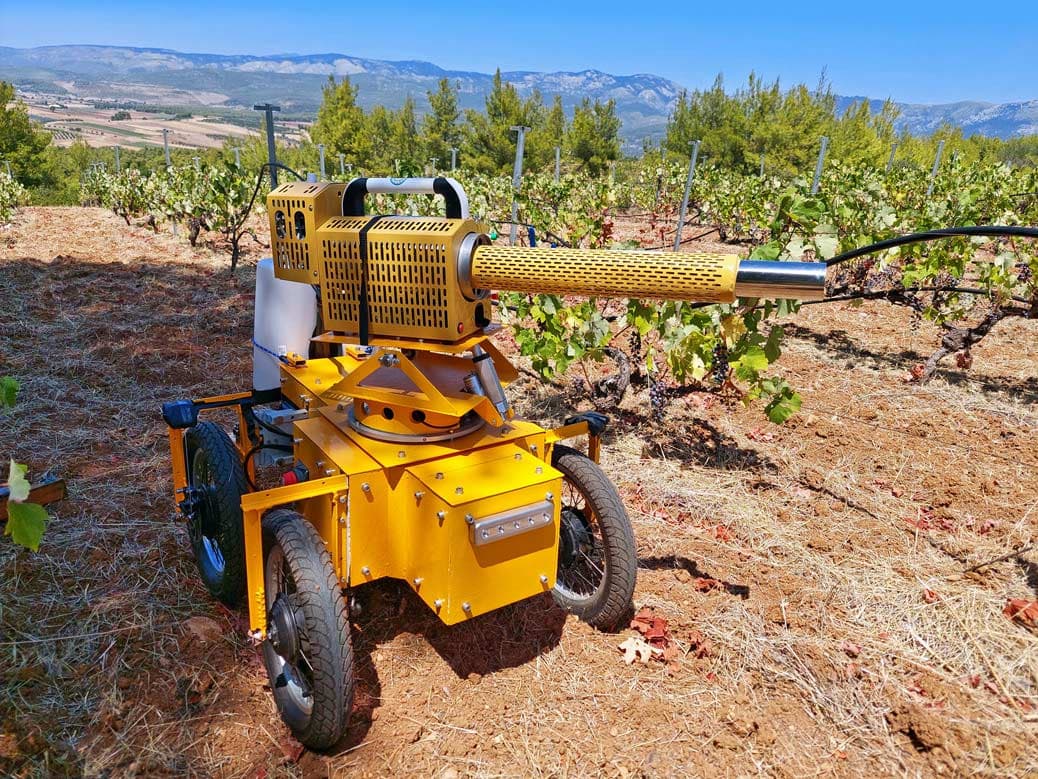
3D preview converted from github.com/meltoner/agrofelis at 3a2ec90, under MIT. View the original files from GitHub (7.6 MB) (opens in a new tab)
- Height
- 497 mm
- Weight
- 121 kg
- Payload
- 250 kg
What it can do
Written by Robotheca from the project's documents.
- Four-wheel-drive mobile base for agricultural field navigation, with a rated payload of 250 kg maximum and 185 kg recommended.
- Maximum speed of 5 km/h and minimum speed of 0.2 km/h.
- Two independent linear actuators steer the vehicle, with a turning radius of 1.04 meters.
- Rotating Implement Mount with two degrees of freedom (rotation and elevation) for mounting implements such as a thermal fogger.
- Remote controller for actuating wheels, steering, brakes and power, with recording and replaying of operations described as a planned capability.
- Vision via an 8 MP camera on the Jetson Nano, with machine vision tasks run on the edge through a Coral AI accelerator.
- Lidar tilted by a servo to capture multiple planes for 3D coverage.
- Components are orchestrated by a Jetson Nano running Linux, using WebSockets to interconnect modules.
Works with AI
Found by Robotheca in the project's files at commit 3a2ec90, its robot.yaml and Robotheca's notes on its documents. Never guessed; Robotheca doesn't run the code.
“Vision via an 8 MP camera on the Jetson Nano, with machine vision tasks run on the edge through a Coral AI accelerator.”
Robotheca's notes: What it can do
Bill of materials
9 parts9 of 9 parts shown
| # | Component | Quantity | Est. price | Supplier |
|---|---|---|---|---|
| 1 | NVIDIA Jetson Nano Developer Kit | – | €199 total | Hellas Digital: buy NVIDIA Jetson Nano Developer Kit, opens in a new tab |
| 2 | High speed ADATA premier one 128gb | – | €81.09 total | Skroutz: buy High speed ADATA premier one 128gb, opens in a new tab |
| 3 | Jetson nano fan | – | €8 total | Hellas Digital: buy Jetson nano fan, opens in a new tab |
| 4 | Jetson nano case | – | €15.80 total | Grobotronics: buy Jetson nano case, opens in a new tab |
| 5 | Coral USB Accelerator | – | €87.90 total | Nettop: buy Coral USB Accelerator, opens in a new tab |
| 6 | 8 MP night vision camera | – | €31.99 total | Hellas Digital: buy 8 MP night vision camera, opens in a new tab |
| 7 | TP-LINK TL-WR802N v4 Wireless Router | – | €24.30 total | Skroutz: buy TP-LINK TL-WR802N v4 Wireless Router, opens in a new tab |
| 8 | 15 Pin Ribbon Flex CSI Cable 100cm | – | €0.67 total | Aliexpress: buy 15 Pin Ribbon Flex CSI Cable 100cm, opens in a new tab |
| 9 | 7 port USB v3.1 HUB | – | €36.59 total | Skroutz: buy 7 port USB v3.1 HUB, opens in a new tab |
Parts total: €485.34. Read from components/connectivity/components.md at the pinned commit.
Build guide
The creator's steps, each with its instructions.
- 1Build the chassis frame from 20x20 mm square iron bars
- 2Fabricate the wheels
- 3Fabricate the wheel forks
- 4Assemble the power system with LiFePO4 batteries and BMS
- 5Fabricate the protective covers
- 6Build the steering system
- 7Assemble the motors hub drivers
- 8Build the front 3D lidar sensor module
- 9Build the two-degree-of-freedom rotating implement mount
- 10Build the remote controller
- 11Set up the computing elements and data fusion
The guide appears here as you scroll.
Guide by @meltoner (README.md), under MIT.
More guides
Wiring and electronics
Notes written by Robotheca from the project's documents.
Main parts
- NVIDIA Jetson Nano Developer Kit as the main computing element, with a 128 GB storage drive and a fan and case.
- Google Coral USB Accelerator for edge machine vision.
- 8 MP night vision camera connected to the Jetson Nano.
- ESP32 and Arduino modules handle sensors and actuators in the modular subsystems.
- Motors Hub Driver module controlling in-wheel motor hubs via ESP32, with hall sensor reading through an ADC, current sensors and relays.
- Lidar sensor with a servo for tilting, plus an MPU and GPS sensor in the front sensors module.
- TP-LINK TL-WR802N v4 wireless router providing the local WiFi network.
- LiFePO4 battery pack (8 elements) with a battery management system, rated for 20 to 29.2 volts and 302 amps.
- Disc brakes actuated by servos and linear actuators for steering.
Connections
- The Jetson Nano connects to the camera through a 15-pin ribbon flex CSI cable.
- A 7-port USB 3.1 hub connects peripherals to the Jetson Nano, and the Coral accelerator taps into the USB 3 interface.
- Modules communicate over the local WiFi network and the USB bus, with ESP32 passing Lidar serial data and sensor data over USB.
- The power system distributes different voltages to the electronics, with relays and protective mechanisms in the power distribution.
- Motors Hub Driver power sub-module uses relays, current sensors and logic level converters between the controller and motor hubs.
Cables and connectors
From the parts list.
- 15 Pin Ribbon Flex CSI Cable 100cm
Schematics, boards and diagrams
- components/connectivity/_figures/computing-06-0-schematic.pngDiagram
- components/connectivity/_figures/pdf/computing-06-0-schematic.pdfDiagram
- components/remote-control/_figures/pdf/hlighted-remote-control-02-module-schematics.pdfDiagram
- components/remote-control/_figures/pdf/remote-control-01-structure-schematics.pdfDiagram
- components/remote-control/_figures/pdf/remote-control-02-module-schematics.pdfDiagram
- components/remote-control/_figures/remote-control-01-module-schematics.pngDiagram
- components/remote-control/_figures/remote-control-03-structure-schematics.pngDiagram
- components/vehicle-steering/_figures/pdf/vehicle-steering-23_STEERING_DRIVER_connections.pdfDiagram
- components/vehicle-steering/_figures/vehicle-steering-23_STEERING_DRIVER_connections.pngDiagram
- introduction/_figures/unselected/01_agrofelis-robot-schematics.pngDiagram
- introduction/_figures/unselected/03_agrofelis-robot-implement-mount-schematic.pngDiagram


